Showing posts with label steampunk. Show all posts

Saturday, March 8, 2014

Mainspring


       Okay, so the rundown is as follows. For all the lavish, bright, interesting points of Mainspring, Jay Lake's novel falls flat for the most part. It's rushed in the good parts and padded everywhere else, the characters don't seem to matter other than as props, and the main character doesn't really show enough growth to make his journey make sense. It's a loud, empty mess that might be a good read if you take it slow and get it out from the library, but I cannot recommend in normal circumstances. It's got good worldbuilding, but that's not enough to save it.

More, as always, below.

Saturday, January 25, 2014

The Rise of the Iron Moon


          Okay, so the rundown is as follows. There is a good book in Stephen Hunt's The Rise of the Iron Moon. Somewhere. When he isn't gleefully destroying the beautiful setting he spent two books building up, or borrowing liberally from Jules Verne and HG Wells. Said good book is hiding in a mass of strange narrative choices, long passages of debate and exposition, characters spending their time not fighting a superior force sweeping across the land, and some rather bizarre takes on Arthurian mythology. Also, as this is a concluding volume to the arc started in The Court of the Air, foreknowledge of which is required to read this book. 

                 The good bits are that when the book is going, it really gets going, Stephen Hunt's usual attention to detail and worldbuilding do shine through in places, there is a genuine sense of urgency to some scenes, and I like the way some of the bits do come together. Also, there are some fantastic plot elements. 

                 However, in the end, I cannot recommend this book to all but the most ardent of Hunt's fans, or those wondering about the ultimate fates of the characters from the first two books. Find it in the library, buy it if you find it used and plan on passing it off, but this one's for collectors and die-hard fans, and there are plenty of books that are time better spent.

More, as always, below.

Thursday, September 5, 2013

The Half-Made World


    Okay, the rundown is as follows. Felix Gilman has written an amazing book here that is dragged down at the end of its length by characters that don't completely matter and a plotline that stops instead of ends. While a "no ending" ending can be pulled off well, this one isn't, and makes me question how many of the reviewers read the book to the end.

              However, it is brilliantly written (if disappointing in places), and if you can enjoy the journey more than the destination, I'd recommend this to anyone with a love of weird fiction and steampunk/dieselpunk narratives. Take it out from the library and give it a whirl, maybe you'll find more here that's cool than I did in the end. 

More, as always, below. 

Tuesday, August 28, 2012

Agatha H. and the Clockwork Princess

As part of an experimental format, I am posting the epigraph and image just before a sort of "capsule" review of the book. The real review will be below the jump. Like it? Hate it? Wish to rant about the sad state of literary affairs in the world? Please tell me in the comments. This blog, as always, is an organic and ever-changing process, and the cooler I can make it, the better off both I and my readers will be.

ALSO: I am going on a longer vacation, so no review next Saturday. I need to calm down so I can concentrate on getting you the best reviews I can, delivered on-schedule and without having to rush and not finish the book all the way. There may also be a renaissance faire involved.


"It is here, with great reluctance, and a full awareness of how a chronicler should report a story without being the story itself, that one of your professors enters the narrative. Surely the tedious whys and wherefores of how he came to find himself in this particular prison at this particular time have no significant relevance to the greater story and shall thus be ignored."
- Professor Philip Foglio

           So, to get the basics out of the way, Agatha H. and the Clockwork Princess is the second novelization of Phil and Kaja Foglio's Girl Genius* webcomic series, a series born from a love of pulp, steampunk, comic fiction, and possibly monsters with teeth bigger than their faces. In it, the main character, Agatha Heterodyne survives an airship crash into the terrifying area of an alternate steampunk Transylvania known as "The Wasteland". To get her safely to the city of Mechanicsburg without being eaten by the terrifying monsters or crushed by steam-powered robots, she joins a traveling circus and hopes to have an uneventful time. But soon intrigues and adventure find her, and she is swept up in an adventure involving her lineage, lost princesses, and insane gadgetry.
          The book is incredibly well-done, though it suffers from a minor lack of context in the opening pages and occasional typographical errors in the edition I own. The descriptions are fantastically detailed, the sense of humor is frenetic but manages to let the reader catch up, and even the momentary self-insert is played self-deprecatingly for comedy. If you have ever wanted an adventure story that is just straight-out flat-out fun; with engaging characters, a good sense of humor, and a self-aware quality that engages the reader rather than ironically detaching them to poke fun at itself, this is your book. I love it, I thoroughly recommend you should buy it, and then once you've bought it, press it eagerly into your friends' hands with only a meaningful look and the words "read this".

(Complete review after the jump)

Sunday, August 12, 2012

Secrets of the Fire Sea


"And every so often, it's time for you to stand up and take responsibility for your own actions."
- Badger-headed Joseph

                I've wondered for a while now why I seem to like Stephen Hunt's novels of strange pulp fiction, but by the same turn seem to dislike most retro-future and steampunk novels. Part of it could be that, as I said, steampunk is very hard to get right, with most people simply pandering to the airships-and-cogs crowd. But I think the answer lies a little deeper than that:

The best steampunk writers, in my opinion, don't strictly write steampunk.

               Now, part of this has to do with steampunk being more or less a broadly-defined genre. For a book to be steampunk, usually it's science fiction transposed to the Victorian era with some minor magical elements to tie together how in Hell a society can do all the things they can when the only devices they have are steam-powered. On the surface, it seems like a very simple definition, and one in my youthful folly I claimed wasn't that hard to screw up. However, it appears that simply stopping with that is pretty much what separates the good from the bad.
  
              F'rinstance, take Secrets of the Fire Sea. In this book, we have elements of pulp adventure stories, high fantasy, hard SF, detective stories, cyberpunk*, post-apocalyptic fiction, and about six or seven other things I may have forgotten that just wound up all wrapped up in there. It's probably got some elements of cosmic horror and, well, regular horror there, too. Stephen Hunt isn't content to just stop with one genre of fantastic fiction, he has to have them all. And use them all at the same time. 

              Secrets of the Fire Sea takes a new direction for Stephen Hunt's Jackals Sextology**, not setting any of the story in the Kingdom of Jackals and playing with its many devices, but moving the action to the island of Jago. Jago is an island nation with a single city comprised of hermetically sealed vaults in the middle of the titular sea. The nation is home to one Hannah Conquest, a young mathematician who wishes to join the Rationalist Circlist Church. Hannah lives with her guardian, the Archbishop of Jago, until suddenly the Archbishop's murder**** leaves her indentured to the sinister Guild of Valvemen and forced into a power struggle almost centuries in the making. At the same time, a group from Jackals comes to Jago to investigate both the murder of the Archbishop, and the research left by archaeologists who died under mysterious circumstances. Naturally, the two plots split, and interweave, and finally come crashing together in a brilliant fury at the end of the book, an explosion of steam-bots, battle scenes, and sentient bears.

           Oh. Yeah. There are sentient bear-people in this. It's a little jarring at first, especially since there aren't many sentient non-human races in Hunt's novels, but you get used to them pretty quick. 

           What makes this book worth reading, however, is the sheer staggering amount of stuff in the novel. Stephen Hunt's always been an imaginative author, and the world of Jackals hasn't ever gone without its share of cool concepts, and this book is no exception. Jago's defenses and power plants (which hew closer to dieselpunk than steampunk) are heavily detailed, and the familiar grotesque nature of the world is definitely on display-- the Valvemen all seem to be dying from radiation poisoning, the "stained senate" is governed by a senile man with a foot fetish, and the cities are being swallowed up both by the sea and the feral beasts beyond the walls. The hacking sequences, too, are all very lovingly detailed, short on mathematics but still holding true to most of the conventions of actual hacking-- long commands and mathematics rather than flailing wildly, and the idea that it can't do everything.

         Another great thing about Stephen Hunt's books as a whole is the characters. Hunt will usually take minor characters from his work and turn them into major characters in others. In this one, Jethro Daunt and his companion Boxiron become major players, as well as a research assistant from The Kingdom Beyond The Waves. The fact that these stories do feel like parts of a larger world where every character plays their own part in different stories helps to tie the sense of the world together, and definitely helps with the overall plots of the book.

          However, there are a few issues. Hunt can't seem to stick to one plotline, or even one set of villains. While in previous books the plot twists were set up in advance, here the plots tend to come out of nowhere and change without warning. Literally the last hundred and thirty words had me yelling "What?! No!" as I tried to make sense of exactly what was going on. The book cuts back and forth too quickly, and the main villain for most of the first half of the book suddenly and without warning is neutralized and shrugged off. They spend the rest of the book more or less as a persona non grata while other factions come out of the wings. The final plot twist is actually so random as to count as nonsensical. On top of this, Hunt cuts around too damn fast. There are even some plot elements he just drops completely. F'rinstance, what's the whole deal with the creepy chamber in the basement of the Guild's stronghold? Never comes up at all.

        The other problem I have is how Hunt handles death. With a precious few notable exceptions, most characters in Hunt's novels are pretty much dumped unceremoniously without a second thought, leaving characters who have sometimes been with you through the entire book suddenly tossed off the page without a second thought. Hunt has done this before, in Kingdom Beyond the Waves, and it was just as annoying then as it was now. In particular, the character he does it with deserved a much better death, once again.

         But in the end, despite the plot's breakdown and all the silly twists and character deaths, this is a book worth reading, especially if you enjoy steampunk or pulp-style adventures. It has some imaginative ideas, some very good setpieces, and while it's lesser when compared to the previous novels in the series, an iffy Stephen Hunt book is still a damn good book. Maybe not a must-buy and read for everyone, but a good read nonetheless, and an essential book for fans of the series.


NEXT WEEK:
The Demi-Monde: Winter

STILL TO COME:
Good Omens as a classic review. So I can see what I think of it twenty years after its debut, and ten years after I read it.
Imajica
The Half-Made World


*Victorian-age computer hacking! All over the damn place!
**Writing that word makes me feel dirty...maybe not as much as his abandonment of the really cool cover scheme he had going until he swapped publishers, but still. 
***What is his deal with all these orphans? Seriously. 
****Once again, spoilers be damned, they say so on the farging dust jacket

Saturday, May 21, 2011

Enigmatic Pilot


Everything truly dangerous is afraid of itself, and cannot resist a mirror
- The Narrator

           Constant readers of this blog doubtless know that I am a big fan of the works of Kris Saknussemm. My very first review was nothing short of glowing, and Zanesville, while flawed, was a fantastic debut novel. That this is the case makes it hurt even more that he has managed to disappoint me in such a manner with his current book. When I heard it was coming out in March, I was nothing less than overjoyed. That joy only grew when I found out he was doing it as a prequel to Zanesville, which meant in all likelihood that the same irreverent, gonzo tone that I'd found so endearing the first time around. When I finally interlibrary loaned the book and brought it home, I settled down to read it and was promptly so disappointed that I threw the damn book across the room.
           I don't know what I was expecting, but a limp, quasi-historical steampunk book was just about the last thing on my mind. The book starts off in the middle of a civil war reconnaissance mission, which ends with a strange figure bearing the familiar wheelbarrow-and-fire symbol of the good guys throwing a blanket across the sky and performing other strange, unsettling tricks. Then we jump to Zanesville, Ohio in the mid-1800s, and the events of the prologue (while they hint at the strange figure on the battlefield being Lloyd) are never mentioned again. The book follows the strange messianic figure from Zanesville, Lloyd Meadhorn Sitturd, a mechanical and scientific genius even at age six, during his youth. Lloyd and his family get a message from an uncle in Texas, telling them that they're needed. Because a free black family in Antebellum Ohio doesn't go over too well, they jump at the offer and set off on a riverboat towards the town of Freedom. On the way, Lloyd meets an unsettling cast of characters, all of whom want to use his gifts for their own ends, and many of whom are more dangerous than they first appear. It plays out as a coming of age story with one final twist that I have to admit, was kind of surprising and cool. But overall, I couldn't stand this book.
            I suppose my problem with it is multi-part. The first of these would be that it just doesn't match the same out-there tone of his other work. Where Zanesville was a black comedy in fun-house colors and Private Midnight was James Ellroy on bad acid, both very much insane and yet entirely acceptable in their own way, Enigmatic Pilot felt like Saknussemm trying and failing to restrain himself...to write something fairly conventional and still having odd elements here and there. Were this anyone else, or were it a first novel, then I'd praise it. But once again, as with Richard Kadrey, I know Saknussemm can do so much better and he just doesn't. This feels like someone trying to emulate Saknussemm, or even Tim Powers, and not really getting it. In fact, this feels like someone going on a steampunk binge, then an American history binge, and then trying to write a novel combining it all together. While there are some cool ideas, including the music-box people and the character of St. Ives (a gambler with the steampunk equivalent of a bionic hand), there just isn't enough to hold my attention for three hundred pages.
           Which leads me right to my next problem. In a book about people travelling across the country, things tend to stop with almost astonishing regularity. Each section of the book spends a significant amount of time in one of the cities that the Sitturds stop in, most of the time because it's significant to Lloyd's development, and occasionally because there's something important to the plot that goes on there. What's supposed to happen is a frantic chase from city to city as they get driven to the next location and must contend with the dangers and whatnot there. What happens instead is a halting narrative where the cool ideas collapse under the groaning and lethargic nature of the plot. Despite the occasional threat of two ancient conspiracies (both who want Lloyd because of his massive intellect and abilities), the plot and indeed Lloyd's development as a result are in no hurry to get anywhere. For all the time it took, you would think the book would get to Texas by the end, at least to set up the next book (this having been billed as a series, after all)
            But no. While by the end, there are some interesting dream sequences (or are they?) and one of the best final lines I've had in a book, they never get to Texas. In fact, there isn't even a real ending to the book. It just stops short of answering any questions. Now, while before I'd be willing to forgive Saknussemm for such a thing, that a book like this ambles along without giving us any idea of what's going on and doesn't even include a payoff is just unacceptable. Books can have no ending, but the non-ending has to occur organically. If your plot just stops and shrugs and goes "that's it, that's the end of that", then I can't condone it. 
           Finally, the book explains mysteries that never needed to be explained to begin with. I think this is the most egregious of its sins. Part of the fun of Zanesville was the mystery surrounding the protagonist and his origins. Now that the mysterious benefactor/god figure of the last book has been laid out in perfect, pretty detail in front of us, it's kind of pointless. If you know everything about the story, if all the mysteries are solved and very few new ones introduced, it's just kind of sad. For example, knowing that Vitessa (from Zanesville) is not only an evil corporation, but has existed since the eighteen hundreds and is run by an ancient conspiracy that might be from another dimension only serves to further distance this book from its predecessor. Part of this is the curse of the prequel...that any prequel to a work will only raise questions and explain things that don't need to be explained. And part of this is just the annoying nature of the book.
          So while there are bright spots, give this one a miss. It's a sad misstep from the previous nuts books. While I still look forward to anything Kris Saknussemm does, this is just disappointing and definitely not worth your time.

Still to come:

- Tim Dorsey's Electric Barracuda
- Jeffrey Ford's The Physiognomy
- Tim Powers's On Stranger Tides
- And when I can fit it in, a new "doorstopper" series with Thomas Pynchon's classic novel Gravity's Rainbow 

Wednesday, December 29, 2010

Perdido Street Station

I thoroughly apologize for the delay. I was snowed in this holiday season and left without my usual set of tools at my disposal. Now, without further ado...


"I remember when The Weaver changed its tastes, it took us three deaths before we worked out what it wanted."
- Mayor Rudgutter

          Hello and I hope you all had a wonderful gift-giving winter festival type thing. I had an eventful one, possibly even an interesting one myself. But before I get too far off track here, let's away into the review and have at it, shall we?
          In every author's body of work, there is always one work that stands as a "breakout". Neal Stephenson had two books published before it, but Snow Crash is the one that seems to stick in everyone's head like a bad pop song. Anthony Burgess is (and he is probably viciously angry about it in his chosen afterlife) best known for A Clockwork Orange despite writing literally hundreds of other books. Neil Gaiman very quietly inched himself along as a journalist, television writer, and short story writer before The Sandman blew him on to the world literary stage. And China Mieville has Perdido Street Station. 
           The book is a dense, grotesque work, choosing to show not just how one character or a set of characters are affected by the malevolent forces at work, but how the entire city of New Crobuzon is affected-- from the criminals and barflies on the low end of the rung all the way up to the corrupt political offices of Parliament The idea that the problem affects the whole city, as well as the ability to show it, is rare in works, and really marks Mieville's ability, as well as the scope of the novel. It's ambitious, particularly considering this was his second novel. And this book does have it all-- horror, insanity, a well-described environment, tight scenes, and a complex but entirely manageable political structure. So naturally, it has everything that would attract me to it.
           Perdido Street Station begins with an injured birdman named Yagarhek approaching a rogue scientist named Isaac. Isaac does his work in the nebulous field known as "Crisis Physics", a field that seems to involve doing random mad sciencey things to inanimate objects to put them into danger, in the hope that they will release "crisis energy", a force that bends reality itself. Yagarhek has been wounded, you see, and his wings have been severed from his body for a crime he speaks of but that makes no sense, a crime called "Second-degree choice-theft". He commissions Isaac for quite a bit of money to produce new wings or a new flight engine for him to use. Isaac sets about working on the idea of flight, dissecting birds and insects, putting out a general call for anything that he can study, be it larval, pupal, or fully formed. An informant gets some criminals to do the legwork, and one of them brings Isaac a rather large caterpillar that only eats hallucinogenic drugs known as "dreamshit". A caterpillar with a strange and checkered history with certain secret departments inside the Parliament. And when it decides it's time to metamorphose, the city quickly spirals towards disaster, ensuring that no one fully escapes the chaos Isaac's little pet leaves in its wake. 
             What makes this book great is all the care and detail that goes into it. You're dropped into New Crobuzon not as the author feels it out, but as a fully-formed city. Things unfold gradually, but they have the feeling of being established since the word "go". The protagonists don't initiate things so much as simply speed them along with the monkey wrench of the escaped moth and their subsequent quest to figure out exactly what it is and what it's doing in the city. A city that's explored in more detail than necessary, even-- every corner of New Crobuzon is given almost a page of description, such as the disgusting Remade, a class of criminal whose crimes were so heinous that through a mixture of thaumaturgy and sorcery they have been turned into grotesque walking art exhibits, the tamest of which would be the child-murdering mother who had her infant's limbs grafted on to her face, or maybe the informant who had his mouth sealed over. The moths (yes, plural) and their completely alien design are another example of too much information, but all of it makes a complex and almost independently intelligent setting-- malevolent, given that pretty much everyone is corrupt, but complex and independent nonetheless.
                In terms of morality, Perdido falls slightly towards the "Richard Kadrey" side of the sliding scale, though this is by no means a failing. The characters are flawed, but since we spend time with each of them (save for the freakish moths), we get to understand why they do the things they do. The heroes are a particularly good example of this, as while Isaac is a moral and ethical void that rivals other mad scientists of the genre, he realizes when things have gone too far and tries to halt the vicious mechanism he gave birth to in the first place. Isaac serves as a hero who slowly realizes what is going on around him is wrong, leading to several moments of genuine emotion and growth. The other characters, as well, start out in their initial stiff archetypes, as one would find in such books as Ghosts of Manhattan, but soon they grow and twist out of their initial roles and come into their own. By the end, you know who they are and why they do what they do, because their setting and their personal growth all inform what they have become. The final scenes show Isaac having grown but at the same time realizing that he, despite all his imaginings otherwise, is still human and still gets his share of bad fortune at the very end of things. While he triumphs, there is sacrifice.
                 I suppose if I had any bones to pick with the book, it would be that there are points where the book definitely drags. Yes, the politics are all important, yes we need to see everything because it's really about the city, but they should be quicker. Hit-and-run and get back to the plot at hand. The way they are now, they provide valuable and (here's that overused word again) detailed insight, but it's too much at times. Also, once again, Mieville lets his setting run away with the book, allowing the city to at times overwhelm its inhabitants. In the end, though, these small quibbles actually work in the book's favor for the most part. 
                 Yes, in the end, this is a fantastic book, much better than Kraken, his later outing, which tried to do the same thing but in a modern-day setting. Mieville's world-building skills are unmatched and unrivaled, and his instincts are fantastic. With New Crobuzon, Mieville creates a disgusting but beautiful and intriguing world, and with his story full of creepy, arcane systems and mechanisms, he creates the perfect play for its stage. This is one worth buying and reading over and over again, a thoroughly enjoyable work that marks a fantastic creation from a fantastic author.

Next week: Steampunk Month comes to a close with a review of The Steampunk Trilogy by the remarkably strange Paul DiFilippo, and I do the best books (new and old) that I've read this year, possibly on video. Have a great New Year's!

Saturday, December 18, 2010

The Strange Affair of Spring-Heeled Jack

            
"Burton! This is all your fault! Do what you're supposed to!"
- Spring Heeled Jack

              When Barry Hughart was writing his classic novel Bridge of Birds, he says that he had "A lot of cool ideas, but when I took a look at it, the book wasn't really about anything. So I put it in a drawer...and then it dawned on me-- this book should be about love. So it was, and the rest of them were, too." And that's the sense I get from Mark Hodder's book The Strange Affair of Spring Heeled Jack-- it should have been about something. Oh, granted, the plot is fun, and there are a lot of great ideas, but it doesn't seem to have any grounding, which is kind of important to any plot. And it's a shame. A quick glance at the other reviews on this site would tell you I really should have liked this book a lot more than I did. The author is well-read and knows what he's doing, the steampunk ideas he integrates are really original, with eugenics and magic being mixed in with all the rest, but the way he presented things fell short and definitely didn't do justice to any of the concepts he was introducing. 
               I'll explain: The plot takes place in a Victorian England, but not the Victorian age we know so well. No, due to something happening, it has veered wildly off course. Eugenicists breed talking dogs and parakeets who relay messages, there are subway and elevated rail systems running throughout the country, and various other morally and ethically removed elements are becoming commonplace. Into this strange world walks our hero, Sir Richard Francis Burton, a man who has spent much time exploring abroad and has returned to debate his onetime friend, John Hanning Speke, over the source of the Nile, or at least is supposed to until Speke shoots himself in the face. Shortly after that, Burton is accosted by a man wearing springlike stilts on his feet, and shortly after that is offered the chance to become the King's Agent and figure out why London is being plagued by red-robed, spontaneously combusting werewolves. With him are poet and masochist Algernon Swinburne, the corpulent DI Trounce, and a rather bizarre cast of characters, almost all of whom are taken from British history. For some reason, the strange figure who assaulted Burton, a man nicknamed "Spring Heeled Jack", keeps talking about how the natural order of history is upset, and Burton must get to the bottom of all these mysteries to protect the crown and country.
               The problems with the book come in when the setting overwhelms the plot and characters. Mark Hodder has done himself a great disservice here, as in setting up his world as an alternate history to ours (the ultimate culprit is a time traveler who made one fatal mistake and is trying to reintegrate himself into existence) he has cast fictional versions of real people (with one major exception) to carry out his plots. Had this been an adventure story with characters completely separate from history, elements of it would not have been quite the same, but the setting would have been served better. Hodder obviously has a great deal of potential as a writer, but at the same time, his sense of play and his need to treat historical figures like his own personal action figures drags everything down. Burton is a fantastic protagonist, sharing his bloodline with such great fictional detectives as Sexton Blake and Sherlock Holmes with his mastery of disguise, mesmerism, and the sword; the problem lies in his being an actual person and thus being dwarfed by the setting at hand. Hodder wants to explore the future of this timeline and the people in it (Oscar Wilde shows up as a nine year old newsboy for almost no reason but to be there.), but seems to have less commitment to the plot. The book suffers for this in gross quantities, eventually toppling under the weight of its own cool ideas by the end (though the character of Isambard Kingdom Brunel as a massive steampunk robot octopus is actually kind of funny). 
               That isn't to say that the plot isn't interesting. While the first few chapters start off slowly, the first and third sections of the book are intriguing and gripping. Watching Burton and Swinburne run down leads in a succession of pub crawls and fights is a lot of fun to watch, and while the action flags, they are brief moments between a lot of truly fantastic seqences. The Battle of Old Ford (which makes up all of the climax) is handled not from the overhead perspective Stephen Hunt favors, but from a more personal level as Burton and Trounce smash and slice their way through the ground troops of the villainous Mr. Belljar (an orangutan with a brain in a jar on his head in a nice nod to Murders of the Rue Morgue and simultaneously '50s horror) and his army of sinister Libertines. The titular Spring-Heeled Jack is handled with just the right amount of pathos in his sections, and they would be interesting on their own, but in the end they serve mainly to slow the story to a crawl right before the big climactic airship (you knew that was coming) battle with Mr. Belljar and the bloated, two-brained grotesquerie that is Charles Darwin. The ending pathos and moral choice made by Burton are emotionally tugging, and the book even shines through in some moments with some pitch black humor. 
               I suppose the problem with the book is that Mark Hodder tried to write two books and smoosh them together...in one, Burton and Swinburne must stop an evil and insane cabal in an adventure reminiscient of Mark Frost's The List of 7. In another, a time traveler must stop his ancestor from assassinating Queen Victoria, or alternately find some way to reintegrate himself into the timeline. While the interesting central idea is what makes the book turn and gives it focus, the problem is that the two halves don't really fit together. One should be separate from the other entirely. Put together, both elements which would have been strong on their own are weaker until the final scene, where Burton (after being told he has to make a choice) decides "I like the world I live in now.", a moment both touching and intriguing in its own way. Better yet, perhaps he should have tried to find an illustrator and do a half-guidebook, half-story novel about the way his Victorian society is different from now, a la James Gurney's excellent (so excellent George Lucas repeatedly poached from it) Dinotopia. Instead, what we get is a work chock-full of ideas, but none of which connect.
                   In the end, the book is definitely worth a read if you enjoy steampunk, or even just strange science fiction or fantasy literature. The Strange Affair of Spring Heeled Jack isn't as good as, say, The Court of the Air or The Glass Books of the Dream Eaters (which handled a similar story much better, though it had its own set of problems), but while I would caution one not to buy it, I do give it a mild recommendation. It's an okay book, though not good or great, and it makes me want to see more of Mark Hodder's work, though hopefully separating his writing from his history. 


Next Week: In what seems to have become Steampunk Month (despite that slight sidestep for the Richard Kadrey novel), the more grotesque and insane side of the genre is shown with one of China Mieville's New Crobuzon novels, Perdido Street Station, or perhaps The Scar. See you then.

Wednesday, December 8, 2010

Ghosts of Manhattan

So, due to two back-to-back spontaneous vacations, this blog wound up on hiatus for too damn long. I will be posting three reviews in the next few days. Hope you enjoy and sorry I kept things in suspense.


"He was going for a gun. Today...today we do it your way."
- Detective Donovan

        I hate it when a reviewer starts out a dissenting review with "I tried to like this book, I really did." It's been used sincerely, and I respect people who can, but it's also one of those things people use on Amazon (which has a level of intelligent discourse like the infinitely more infamous XBOX Live only with people reviewing books instead of playing Halo and Battlefield) when they want to say "Hey, I'm on your side, so take this bad review of a book seriously!" along with "I've been a fan of (Insert genre/author here), but this is..." and trashing the book. 

        The problem being, I really should like Ghosts of Manhattan. It's a superhero story set in a steampunk version of the pulp era. There really isn't another alley that one could say was mine...I'm a huge fan of steampunk, Boardwalk Empire, The Shadow, and detective stories. On top of that, George Mann is a widely acclaimed author whose book The Affinity Bridge is considered a classic of the genre. But Ghosts of Manhattan, to put it mildly, is ridiculous crap. And with a declaration like that, I'm prepared to back it up. So, without any further ado, let's get to it.

         Ghosts of Manhattan is the story of a steam-powered version of Manhattan-- Cars have funnels on them, airships dot the skies, and holographic advertisements are common. Think a futuristic city, but done completely with retro overtones. In this city, the main antagonist is a crimeboss known only as The Roman, a man who inexplicably seems to do a decent share of his own dirty work and leaves a pair of denarii on the victims' eyes as a calling card. His right hand man, Gideon, holds sway over New York City with a supercharged (we know this because it has three funnels on it. Three!) car, an army of moss golems, and a custom-made pistol. Opposing him are the one honest cop in the city, a lounge singer with a secret (of course), and the hero known as "The Ghost", a technological genius and former war vet. Also embroiled in the mess is Gabriel Cross, a wealthy playboy and you can see where this is going from there. The Roman turns out to be a threat to all existence with some unsettling ties to otherworldly powers (of course), and The Ghost, the lounge singer, and the Honest Cop(tm) must band together against the forces of darkness to save the city and perhaps the world (of course). 

             I suppose the first problem with this Lovecraftian abomination of a book is that it insults the reader's intelligence. To give an example, let's start with the character of The Ghost. Here we have someone like Bruce Wayne, with one difference: Everyone knows Bruce Wayne is Batman. People who haven't even seen or heard much about Batman know that Bruce Wayne is Batman. It goes without saying. That's part of writing about superheroes-- you let the reader in on the game early and then you let them tag along to interesting places after that. 

              So why the hell would George Mann, in creating a Batman-style character, want to try and mislead everyone into thinking that the billionaire playboy war vet isn't the masked superhero raising hell and shooting lethal explosive darts into mobsters' heads? I mean, he could be trying to be original, but come on-- when there's a superhero and there's a billionaire playboy with some questionable nighttime activities, everyone knows the score. No, I believe that George Mann just thinks his entire readership is dumber than primordial syrup and is willing to believe that they're different people until the big reveal comes up to shock and surprise them. In this regard, Mann is like a magician who very obviously palms a coin and then tries to explain it as magic when he pretends (with an equally obvious motion) to pull it out of someone's ear.

                Constant readers (few of you that there are) might remember in this review, I stated that steampunk was


  "...a pretty easy job: Just throw around some robots with boilers and some higher technology, and suddenly, boom. Instant steampunk book. Bonus points if you use the word "airship" twice in the same chapter." 


 No one should have any problem with this, normally. After all, it's kind of how the genre works. Nothing wrong with the genre working, right? Well, it's a little harder than I originally outlined. You see, the setpieces and props have to actually connect to the story, not exist in spite of it. It's insulting to write a story with a cool setting and then barely use the setting in places here and there. Yes, the Ghost uses a flechette gun, jet boots, and some pretty cool goggles, and the "holotubes" are a nice touch, but everyone else uses a regular ol' gun, and even the cars are fairly par for everything, save Gideon's. In other words, Mann takes my earlier description of steampunk writing and absuses it like a redheaded stepchild to such a degree that once again, it's like he's insulting the audience. That sort of lazy, dishonest behaviour simply won't cut it. No author should ever treat his readers like this. 

                        The characterization is terrible, too. Those archetypes I mentioned earlier? Yeah, that's the whole character for each of those. It's like the writer went through a list of every possible trope they could and took the basest possible meaning for each. (The links, in order, are the hero of the piece, the lounge singer girlfriend (or at least her secret), the honest cop (tm), Gideon, and The Roman) What makes it worse is that the hero is named Gabriel Cross, and one of the villains is Gideon Reece, which leads to some confusion, given the biblical names that begin with G and the fact that their first names are mentioned far more than their last names. These are not interesting people, or even fully-formed characters. They are stand-up carboard cutouts that move and talk vaguely like people. They are fucking pod people. This is not what an author does. This is what a lazy mouth-breather with a book to write does.

                     Without any characterization, the plot can boil down to "people run around a city, doing random crap and hoping it makes sense to anyone". There's even a biplane chase scene in the final third of the novel. The idiot screwed up a biplane chase. When it happened, I had to stop and wonder "Huh. What the hell is this doing in here? It's screwing up the book." I then went on to wonder exactly why a biplane chase had materialized out of thin air, instead of occurring organically in the novel itself. I never wonder what an action sequence is doing in a book. That's part of what I like about books-- the action sequences. Those nervous moments between characters and how they react to things. 

                      And speaking of missed action sequences, the climax is, pardon my language, shit. It is the syphilis-infected needles on a junk heap of disgusting offal that I refuse to get into the specifics of  in such a classy and respectable establishment as this blog.  The massive doomsday portal had a gigantic "OFF" switch all the heroes seem to miss until after the big world-destroying creature was summoned, the love interest is sacrificed for no reason other than she said so earlier and the plot wants to make her carry through with it, and the villain who has been set up for the better part of two hundred pages is offed from behind. By a single bullet to the head. After previously wiping the floor with Our Hero. That shouldn't happen. Once again, it's the mark of a lazy author when the villain's henchman is given a much bigger (by an exponential magnitude) sendoff than anyone in the book and the head villain is given a bullet in the head in the basement. That there was a massive and horrifying event before it does not clear this of an anticlimax.

                         I suppose there are good things here and there...the ideas presented are interesting, and this had the potential to be a really cool steampunk superhero pulp kinda story. If it wasn't lazy, insulting, and not worth the paper that it was printed on. And some day I will find George Mann, and after I quiet the urge to smash in his face and sensitive private areas for writing such offal, I will buy him a drink and explain to him exactly how offended I am by his travesty of a novel, and how he, long considered an author of note and merit in the field, has let me down. Then I will probably storm off. 
                         For those of you who decided to skip the large reams of scathing invective and insight, I did not like this book. In fact, I do not even  I do not recommend it to anyone, nor would I ever. Avoid it at all costs. That this even was published by a decent fantasy book outlet makes me weep for the publishing industry and apprehensive about what quality books we are getting in the age of ebooks, self publishing, and the like. It's boring, insulting, forced, and none of it makes the slightest bit of sense. There's a plot in there, but not one anyone would feel particularly obligated to follow. Please, please avoid this book. For my sake if not for yours.


Tomorrow: We continue in the vein of strange worlds and stranger technology with Jeff Noon's The Automated Alice, which is better than this, I promise you. 
Friday: A return to Richard Kadrey's L.A. Antihero Stark with Kill The Dead
Next Week: We return to normal schedule with The Affair of Spring-Heeled Jack.


Friday, September 17, 2010

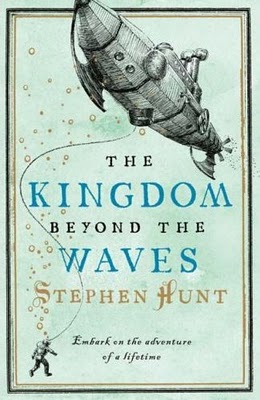
The Kingdom Beyond the Waves


"Bad luck is one fruit you will always find growing in the jungles of Liongeli"


               I found a copy of The Kingdom Beyond the Waves tucked in a back corner of The Strand's science fiction section, on one of the low bookshelves close to the floor, where they keep all the good books. Strangely enough, I picked this up not half a foot away from where I found Johannes Cabal the Necromancer. Why they keep all their best books low to the ground is a mystery, but since they've taken slightly less money from my pocket than Steam and more money than the average GDP of small countries, I suppose it's kind of irrelevant. I'd heard of Stephen Hunt in passing before finding his book on the shelf in The Strand, but that evening, I figured that several coincidences lining up during my day was less random chance and more some kind of serendipity, and so I immediately snapped it up and made my way to the checkout. And I have not regretted the decision since.
                Granted, I'm immensely biased. You see, I'm a big fan of both steampunk and the old pulp-novel aesthetic, so give me a book which combines both those things together, and I'll pretty much be begging to read it. But Kingdom combines them and uses their ideas with such style and grace that it goes beyond the mere eye-candy of an alternate-technology world. A book like this doing its job is a given. It's a pretty easy job: Just throw around some robots with boilers and some higher technology, and suddenly, boom. Instant steampunk book. Bonus points if you use the word "airship" twice in the same chapter. Kingdom, and it's companion book/preceding book The Court of the Air do the job well. Stephen Hunt spent time on his world, and it shows in the care that goes into crafting it. The characters have traditions, obscene gestures...all those little touches that make us know they're part of a bigger world, that they actually have something beyond their own characters.
                 Kingdom begins in a way that will be familiar to anyone who's ever seen the Indiana Jones movies, or pretty much any adventure film: Professor Amelia Harsh, a tomb-raiding rebel archaeologist, is climbing up a mountain with her companions (and aided by her massive, gorilla-like arms) to reach a cache of artifacts from the Black Oil Tribe. The opening sets up the whole tone for the book, from the guns to the crystal grenades, to the feeling that you've stepped into one of the old pulp novels, but, you know, less dry. The professor is raiding archaeological sites to try and find any evidence of the lost city of Camlantis, long since disappeared in an odd form of meteorological phenomena, essentially a "skyquake". Amelia is undertaking the quest to restore some honor to the memory of her father, a suicide after he lost his fortune in stock manipulation. Due to some double-crosses and bad luck with the Caliph, the ruler of the desert she's currently excavating in, Amelia is left crawling through the desert alone, on the verge of death.
                    It would be a very short book if she died in the first chapter, though, and once she gets back, the university she works for promptly throws her out despite her evidence of the lost city. Soon, her sworn enemy makes her an offer to fund an expedition, and Amelia has assembled a crack team of pirates, slavers, a professional scoundrel, and former commandos to head downriver, into the dangerous jungles of Liongeli and find Camlantis-- or die in the attempt. Her hellish cruise through the jungle makes for a good read, and even plays out in a cinematic way. Hunt is excellent with handling fight scenes, focusing first on the energy of the scene and then carrying that through the moments, keeping you invested in the action and reminding you that it isn't just an obligatory scene in his work-- it is vital to survival that these characters win. 
                    The story that alternates with Amelia's story of lost cities, adventure, and tomb-raiding prowess involves a character by the name of Furnace-Breath Nick, a masked vigilante who takes on a job to rescue a rather prominent scientist from the Stalin-ish country of Quatershift. Nick slowly untangles further espionage webs in the style of an old pulp novel like Fantomas or Raffles, a gentleman criminal with a dark side and a mask, fighting evil from the shadows. Eventually, the two stories intertwine quite nicely, but sadly Furnace-Breath's story is the weaker of the two. It's no fun reading a detective adventure when the villain is clearly put right out there, adorned with a neon sign reading "Villain of the book", and accompanying himself on accordion. What little interest there is in Furnace-Breath Nick/Maximilian is quickly quashed when he is revealed to be the brooding, fearful of himself type of hero, like Batman with a homicidal anarcho-psychotic alternate personality.  Yes, we get it, the mask is a necessity you'd rather not have. Considering how much you have to use it, though, we'd like it if you, oh, just shut up about your personal troubles and went back to figuring out what the evil industrialist was really doing.
                      I suppose what I like best about the book is the cinematic quality. I can see every action scene, every fight and flight, laid out in detail. Hunt's book(s) would actually make a good movie, given that pretty much every scene is given such detail that it feels less like you're being dragged through and more like you're a silent and intangible observer. There's a series of fights and action sequences in the middle of the book which really highlight this point, a group of fights, captures, narrow escapes, and betrayals that would seem complex to explain, but simple to go through. Hunt has a good grasp of his setting and what makes sense in it, and all of that comes out on the page, much to my delight. This, and I hate to use such simple words for it, is a good book.
                   Another thing I like, which I mentioned previously, is the attention to detail. There are at least three political systems introduced in the book-- the Free Catosian States, a proper anarchy with loosely-formed Free Companies and gender equality, the parliamentary country of Jackals, where the main characters all come from, and which rules under a somewhat totalitarian form of parliament. Think Cromwell if he went a step or two further with his ideas of governance. And finally, there is the hive-mind of the Liongeli, a complex network encompassing every living thing within it, from the plants to the creatures, all under control of the biological automatons known as the Daggish. In an amazing display of wordsmanship, none of these are dropped in favor of another, though each have their place. 
                       The problems come in with the pacing, though. It is impossible for any writer to continue to keep such an energy level, and while Hunt almost manages to, his lulls are made all the more obvious when they appear. In particular offense is one section at the end. Once the villains' plots have been revealed, the surviving heroes have reached their destinations, and the final desperate battle is obviously in the cards and ready to go on the rails, the book stops cold. Not only is the villain's plan pretty nebulous and a little hard to follow, but the story refuses to go anywhere. This may be a byproduct of a strong story and a weak story meeting together and the elements combining to a mix that makes one go "Well, that's rather plain", but nonetheless, the story runs out of steam. When it gets back up to speed, it doesn't even manage to drag itself back to previous heights. You would think an aerial battle would have much more pep to it, but sadly it doesn't, and the book suffers for it. The saving grace is that the ending brings everything to a nice close, but with just enough plot points to revisit the characters if one wanted to.
                         The other major problem involves one specific incident with the death of a character. For someone who we have spent the whole book with-- and believe me, you'll know when it comes up, it's pretty obvious-- being randomly killed without even a last stand or any real reason other than "someone needed to die in this section" is a little less than the character deserved. It soured some of the sections, though the book recovers nicely from the event and gives us decent storylines for the surviving main characters.
                         Finally, Hunt's obsession with his own grotesque world tends to wear on one after a while. Yes, on one hand we have a kingdom where the hereditary ruler has their arms amputated and spends their life being humiliated by his public, but we don't need to hear about it all the time. Same with the fact that Amelia's arms are "gorilla-like" or "massive" or "oversized". Yes, her arms are huge. Similarly, the constant descriptions of the Greenmesh and its indoctrination process get repetitive after a while. The details are nice, but we don't need to hear about it over and over again. That's just crass.
                         In the end, I suppose that while it isn't always a strong book, it's a highly commendable one. It makes a very good attempt at being a classic adventure story, but less dry than, say the works of H. Rider Haggard or such. Hunt clearly knows what he's doing with his characters and his world. He shows a great deal of love and care to them, gives them interesting things to do, and gives them ends fitting of them. The Kingdom Beyond the Waves is a book worth reading, and worth reading more than once. I am proud to have it on my bookshelf, and am looking forward to any other books Hunt may write.

Next Week: Either Vurt by Jeff Noon, The Lies of Locke Lamora by Scott Lynch, or the start of that Twilight series of reviews I might want to do, depending on what I feel like and what people would rather see me do.