"Bad luck is one fruit you will always find growing in the jungles of Liongeli"
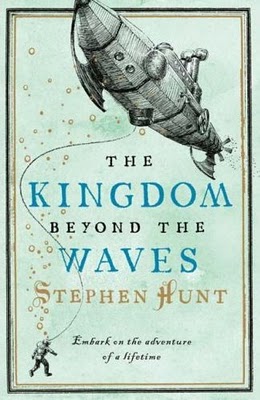
I found a copy of The Kingdom Beyond the Waves tucked in a back corner of The Strand's science fiction section, on one of the low bookshelves close to the floor, where they keep all the good books. Strangely enough, I picked this up not half a foot away from where I found Johannes Cabal the Necromancer. Why they keep all their best books low to the ground is a mystery, but since they've taken slightly less money from my pocket than Steam and more money than the average GDP of small countries, I suppose it's kind of irrelevant. I'd heard of Stephen Hunt in passing before finding his book on the shelf in The Strand, but that evening, I figured that several coincidences lining up during my day was less random chance and more some kind of serendipity, and so I immediately snapped it up and made my way to the checkout. And I have not regretted the decision since. Granted, I'm immensely biased. You see, I'm a big fan of both steampunk and the old pulp-novel aesthetic, so give me a book which combines both those things together, and I'll pretty much be begging to read it. But Kingdom combines them and uses their ideas with such style and grace that it goes beyond the mere eye-candy of an alternate-technology world. A book like this doing its job is a given. It's a pretty easy job: Just throw around some robots with boilers and some higher technology, and suddenly, boom. Instant steampunk book. Bonus points if you use the word "airship" twice in the same chapter. Kingdom, and it's companion book/preceding book The Court of the Air do the job well. Stephen Hunt spent time on his world, and it shows in the care that goes into crafting it. The characters have traditions, obscene gestures...all those little touches that make us know they're part of a bigger world, that they actually have something beyond their own characters.
Kingdom begins in a way that will be familiar to anyone who's ever seen the Indiana Jones movies, or pretty much any adventure film: Professor Amelia Harsh, a tomb-raiding rebel archaeologist, is climbing up a mountain with her companions (and aided by her massive, gorilla-like arms) to reach a cache of artifacts from the Black Oil Tribe. The opening sets up the whole tone for the book, from the guns to the crystal grenades, to the feeling that you've stepped into one of the old pulp novels, but, you know, less dry. The professor is raiding archaeological sites to try and find any evidence of the lost city of Camlantis, long since disappeared in an odd form of meteorological phenomena, essentially a "skyquake". Amelia is undertaking the quest to restore some honor to the memory of her father, a suicide after he lost his fortune in stock manipulation. Due to some double-crosses and bad luck with the Caliph, the ruler of the desert she's currently excavating in, Amelia is left crawling through the desert alone, on the verge of death.
It would be a very short book if she died in the first chapter, though, and once she gets back, the university she works for promptly throws her out despite her evidence of the lost city. Soon, her sworn enemy makes her an offer to fund an expedition, and Amelia has assembled a crack team of pirates, slavers, a professional scoundrel, and former commandos to head downriver, into the dangerous jungles of Liongeli and find Camlantis-- or die in the attempt. Her hellish cruise through the jungle makes for a good read, and even plays out in a cinematic way. Hunt is excellent with handling fight scenes, focusing first on the energy of the scene and then carrying that through the moments, keeping you invested in the action and reminding you that it isn't just an obligatory scene in his work-- it is vital to survival that these characters win.
The story that alternates with Amelia's story of lost cities, adventure, and tomb-raiding prowess involves a character by the name of Furnace-Breath Nick, a masked vigilante who takes on a job to rescue a rather prominent scientist from the Stalin-ish country of Quatershift. Nick slowly untangles further espionage webs in the style of an old pulp novel like Fantomas or Raffles, a gentleman criminal with a dark side and a mask, fighting evil from the shadows. Eventually, the two stories intertwine quite nicely, but sadly Furnace-Breath's story is the weaker of the two. It's no fun reading a detective adventure when the villain is clearly put right out there, adorned with a neon sign reading "Villain of the book", and accompanying himself on accordion. What little interest there is in Furnace-Breath Nick/Maximilian is quickly quashed when he is revealed to be the brooding, fearful of himself type of hero, like Batman with a homicidal anarcho-psychotic alternate personality. Yes, we get it, the mask is a necessity you'd rather not have. Considering how much you have to use it, though, we'd like it if you, oh, just shut up about your personal troubles and went back to figuring out what the evil industrialist was really doing.
I suppose what I like best about the book is the cinematic quality. I can see every action scene, every fight and flight, laid out in detail. Hunt's book(s) would actually make a good movie, given that pretty much every scene is given such detail that it feels less like you're being dragged through and more like you're a silent and intangible observer. There's a series of fights and action sequences in the middle of the book which really highlight this point, a group of fights, captures, narrow escapes, and betrayals that would seem complex to explain, but simple to go through. Hunt has a good grasp of his setting and what makes sense in it, and all of that comes out on the page, much to my delight. This, and I hate to use such simple words for it, is a good book.
Another thing I like, which I mentioned previously, is the attention to detail. There are at least three political systems introduced in the book-- the Free Catosian States, a proper anarchy with loosely-formed Free Companies and gender equality, the parliamentary country of Jackals, where the main characters all come from, and which rules under a somewhat totalitarian form of parliament. Think Cromwell if he went a step or two further with his ideas of governance. And finally, there is the hive-mind of the Liongeli, a complex network encompassing every living thing within it, from the plants to the creatures, all under control of the biological automatons known as the Daggish. In an amazing display of wordsmanship, none of these are dropped in favor of another, though each have their place.
The problems come in with the pacing, though. It is impossible for any writer to continue to keep such an energy level, and while Hunt almost manages to, his lulls are made all the more obvious when they appear. In particular offense is one section at the end. Once the villains' plots have been revealed, the surviving heroes have reached their destinations, and the final desperate battle is obviously in the cards and ready to go on the rails, the book stops cold. Not only is the villain's plan pretty nebulous and a little hard to follow, but the story refuses to go anywhere. This may be a byproduct of a strong story and a weak story meeting together and the elements combining to a mix that makes one go "Well, that's rather plain", but nonetheless, the story runs out of steam. When it gets back up to speed, it doesn't even manage to drag itself back to previous heights. You would think an aerial battle would have much more pep to it, but sadly it doesn't, and the book suffers for it. The saving grace is that the ending brings everything to a nice close, but with just enough plot points to revisit the characters if one wanted to.
The other major problem involves one specific incident with the death of a character. For someone who we have spent the whole book with-- and believe me, you'll know when it comes up, it's pretty obvious-- being randomly killed without even a last stand or any real reason other than "someone needed to die in this section" is a little less than the character deserved. It soured some of the sections, though the book recovers nicely from the event and gives us decent storylines for the surviving main characters.
Finally, Hunt's obsession with his own grotesque world tends to wear on one after a while. Yes, on one hand we have a kingdom where the hereditary ruler has their arms amputated and spends their life being humiliated by his public, but we don't need to hear about it all the time. Same with the fact that Amelia's arms are "gorilla-like" or "massive" or "oversized". Yes, her arms are huge. Similarly, the constant descriptions of the Greenmesh and its indoctrination process get repetitive after a while. The details are nice, but we don't need to hear about it over and over again. That's just crass.
In the end, I suppose that while it isn't always a strong book, it's a highly commendable one. It makes a very good attempt at being a classic adventure story, but less dry than, say the works of H. Rider Haggard or such. Hunt clearly knows what he's doing with his characters and his world. He shows a great deal of love and care to them, gives them interesting things to do, and gives them ends fitting of them. The Kingdom Beyond the Waves is a book worth reading, and worth reading more than once. I am proud to have it on my bookshelf, and am looking forward to any other books Hunt may write.
Next Week: Either Vurt by Jeff Noon, The Lies of Locke Lamora by Scott Lynch, or the start of that Twilight series of reviews I might want to do, depending on what I feel like and what people would rather see me do.