Showing posts with label Horror. Show all posts

Sunday, August 30, 2015

The Scarlet Gospels


                  I waited nine years for this book, and I'm still not completely sure it was worth it.

                   It's a good book, to be sure. And I didn't give up on it the same way I gave up on, say, Abarat (which is a huge rant I will deploy at another time. Maybe for post 200) by the same author. And, let's be honest, any meeting between Harry D'amour (the detective from Great and Secret Show and Lord of Illusions*) and the being people can't help but refer to as "Pinhead" (Him what was in the Hellraiser series**) would be final for one of them, if not both. But I couldn't help feeling like this was possibly a tired and annoyed farewell to his work, melding the dark, beautiful fantasy of his later works (D'amour's dominion) with the brutal, gruesome horror of his earlier works (you know who) in an effort to put them all to bed for good. 

                   I'm not quite sure if it's just because I expected a four to five hundred page doorstopper about the ultimate battle between the reluctant champion of humanity and Barker's most terrifying agent of change, or because it dealt a final blow to stories I hoped would continue and I'm being entitled and pissy. Maybe it's that Barker took one of my favorite characters and flung them in a new direction. But either way, the book annoyed me. 

                   If you're in the mood for a vivid, twisted fantasy involving a team of occult investigators in Hell, great. If you're in the mood for some of the most fucked-up scenes in horror outside of maybe the Edward Lee crowd***, you're in the right place. But I don't believe this'll go on the shelf next to Imajica, The Great and Secret Show, Books of Blood, and Everville

More, as always, below. 

Sunday, April 12, 2015

Miss Peregrine's Home for Peculiar Children


         I like this book in spite of the book. That's the best way I've found to say this. I've been going around and around in circles about Miss Peregrine's Home for Peculiar Children, and what I liked, and what really annoyed me, and it comes down to this: I like the book in spite of what the book is. There's a great dark, atmospheric story that exists within these pages. There's also a great, creepy found-photograph novel. And as this was Ransom Riggs's first novel, and definitely the first novel he wrote with such a concept in mind, And...found document novels or works can be kind of finicky to begin with. Depending on the work, and depending on the source used, it's possible to get any number of permutations, from House of Leaves  to S. to Pale Fire to everything in between. And a novel using creepy Victorian photographs and an abandoned Gothic-novel children's home is...pretty much exactly in my wheelhouse, let's face it. You could get a more Caius book, but only by virtue of the main bulk of my reading material being "very weird shit"*. 

                            But there are...difficulties with this one. The concept needs to hang together a little better than it does, and while it's a fantastic novel, it's kind of hampered by its own premise, a premise that is good on its own, but a little awkward in its execution. But by no means should that discount that the book is full of atmosphere and weirdness, interesting world design, and a very quirky mystery at its heart. 

More, as always, below.

Monday, January 26, 2015

Random Acts of Senseless Violence


       My wish for this year is that just once, just one time, just for a second, there would be a Jack Womack book that I could actually recommend to people. Because he's a good author. And as I slowly maneuver my way through the DryCo books, I do like them quite a bit. The futurespeak isn't completely impenetrable, the plots are intriguing and kind of freaky, and there's something very organic about the world of the books. 

But the ones I've read, I can't recommend. 

                      Random Acts of Senseless Violence doesn't have the problems of Going Going Gone, though. It's technically the first book in the series chronologically, it's written for the most part in conventional language instead of barely-coherent hipster slang, it doesn't slam the doors on any of the worlds it creates, and for the most part, it's a tense, engaging read that posits a near-future United States where society is quickly crumbling and then sticks to it. It manages some moments of intense black humor, memorable characters, and one of the most engaging and human-feeling female leads I've read in years. This is a book that should be reprinted in classic editions and substituted in high schools instead of The Catcher in the Rye, and read and analyzed alongside A Clockwork Orange and Riddley Walker.* This is, by all metrics I have available, an objectively good book.

                       But if I tell you to read this book, I do so with the knowledge it will hold you down and punch your lights out. It will attack you on pure lizard-brain instinct and punch you in the gut so hard and so often it'll become a second career. This is to dystopian literature what Straw Dogs was to romantic movies. 

And I loved every second of it.

More, as always, below.


Thursday, January 8, 2015

Ribblestrop


              In preparation for my first ever break with the format of this blog to review a Young Adult book about a school, I went back and looked up some of the young adult titles of my youth: Wayside School, for one. some of Ellen Raskin's books for another, and Neal Shusterman, and Bruce Coville, and some other titles here and there that I remember digging. And, upon looking back, I realized something: 

YA authors scare the living daylights out of me.

                         Seriously, YA is a genre full of some freaking warped books. And not just the ones they force middle and high schoolers to read at gunpoint, either. I'm talking about the humor books meant for the middle school-age audience, I'm talking about the ridiculous books they let us read thinking "oh, they're all right for kids" that involve stuff like child slavery and brainwashing. The aforementioned Wayside School is a series of linked cosmic horror stories that also work as school comedy. 

                             Now, they're also good books, because most of these people can write. But I did want everyone to know that I have read me some Edward Lee. And some Jack Ketchum. And some Clive Barker. And all the rest. And not once did I find anything nearly as fucked up as I did in young adult fantasy or science fiction or comedy books*.

This brings us to Ribblestrop.

                            In Ribblestrop, Andy Mulligan takes the "school of adventure" tropes that one seems to find reoccuring throughout young adult novels, and blows them so far over the top that it creates an unusual adventure in a school that might as well be unmoored from reality. Despite being ostensibly aimed at the younger set, it's a book full of strange mannequins, kids getting drunk on rum repeatedly, numerous train accidents, and at least one case of nonconsensual trepanation. It's also a book full of heart, and the points where the book gets shaggy make up for it with heart and character and a wicked sense of humor. It's not a book I'd necessarily recommend, but it's fun. And in this case, fun is really all that matters.

Wednesday, December 31, 2014

Revival


Okay, controversial opinion time:

  If  Revival was Stephen King's last work of fiction-- if he wrote no more-- I would be fine with that. 

                   I know he can't stop, I know he won't stop, and I know he's only going to stop when he's all out of stories, and it's a long way to then. But here's the thing: I see Revival as a perfect riff on Stephen King-- all the things I love about him, all the things I think could be a little tighter, and all the things in between. While it may not have been his intent, with Revival, King's written the perfect bookend to his early work in suburban gothic horror, something that ties its past to the traditional pastoral setting while exploring new ways to be disturbing. It's a look at the numerous strange ways someone's life can go, and how we meet the same people in vastly different circumstances throughout our lives. It's about how people can mean so much in one instant and drift off in the next. And it's also a great pastiche of the older titles in the "existential horror" or "cosmic horror" genre, but without much of the difficulty or sheer dryness of those older works. It's a twisted morality tale with a villain who isn't exactly evil and a hero who could never be described as good. 

  And it is brilliant.

Why? More, as always, below

Monday, December 22, 2014

Light


                I've tried to write this intro properly multiple times, but I might as well just put this front and center so those of you who are reading this on the go can get it over with:

Light is one of my favorite books of the year, possibly one of my favorite books of all time

                             I know, I do a whole ton of positive reviews on here, and significantly less dissenting ones, so every book comes out looking really good, but there is no other way to say it. While good books pass constantly through these halls, Light is special even among them. When I was done, I sat there for a few moments, unsure of what to think now that it was over. Then, because seven hours had passed by unnoticed, I was immediately surprised that it was dark outside. It's an engrossing story, one that transcends the boundaries of a genre people feel unnervingly comfortable filing it under. It's a beautiful, well-designed world that seems immense but moves tautly through its places. 

At the very least, folks, reading that paragraph back, it's caused my language center to break down in joy as I revert to stock reviewer phrases normally seen on book blurbs.

                                Light is crazy, brilliant, and I wish I'd managed to finish it the first time I read it, instead of losing interest somewhere around chapter 2 and abandoning it for books I understood better. M. John Harrison is a unique writer and one who stands out even above such titans as Stephenson, Banks, and other more modern writers, and passing up a chance to read this book is a mistake on par with starting a land war in Asia. You may like it as much as I did. You may like it less. All I know is that it moved me, it's brilliantly written and constructed, and I must share this joy with as many of you out there as possible. 

More, as always, below

Sunday, December 7, 2014

This Book Is Full Of Spiders: Seriously, Dude, Don't Touch It


          When I was but a confused and kind of frightened college freshman living in a dorm somewhere in the high desert of New Mexico without many friends or a frame of reference, I took solace in the internet. It was kind of a cautionary prelude to the near-complete agoraphobia I currently find myself dealing with on a semi-regular basis. Honestly...I probably shoulda seen this coming. But in my sort of self-imposed exile in my room, I kept seeing this weird banner with blue eye design. It would pop up on every webcomic, every horror review site, practically everywhere I went, I was followed by this thing like a stalker follows the popular kid at school. It was more annoying than intriguing, but finally it wore me down and I clicked on it. 

                                 The site, johndiesattheend.com, contained a blackly comic novel so good that I had to spam the link as many places as I possibly could, and did so. It was a brilliant work. Not the most tightly-written thing under the sun, but hilarious, and most importantly for my impoverished ass, it was free. Later on, as kind of a "thank you", I actually bought a hardcover copy of the book. I haven't even lent my copy to anyone. And when I found the sequel This Book Is Full Of Spiders came out, I tried to pick up that. Unfortunately, it took me a few years to actually track down one I could pay for, and it wasn't until I randomly found it while looking for something else (Jack Womack's Going Going Gone) that I decided to pick it up and take it home for review. Immediately it promised a story of bizarre experiments, military intervention, and the good sort of weirdness and style that made me try to emulate it multiple times in my own work. 

                             And sadly, it isn't as good. While still unique, and head and shoulders above most of what passes for mainstream works in the bizarro genre these days (lookin' at you, Zombies and Shit), it's a little too polished. A little too safe. The biases are worn a little more clearly on the book's sleeve. So while it's entirely readable, and rightfully so, I'm a little conflicted on this one. I'd say get it from the library or borrow it if you're curious, and then buy it if you really like it. It's certainly weird, and a good read, but the magic just wasn't there for me has much. Especially where it falls apart for me at the end. 

More, as always, below

Tuesday, October 28, 2014

From A Buick 8


                    Length is a hard thing to gauge when writing. I've written several short stories that spun wildly out of control and made me want to see how they'd be in book length, but unfortunately couldn't be due to space requirements. I've also written several book ideas that would be better as single stories, but didn't know how to compress the initial idea. I will say this: Constantly failing at fiction writing has done nothing but teach me how to be a better writer, and if I could ever find a way to make that knowledge useful, believe me, I would. It's also made me great at pointing out where others could be better writers, though I wouldn't be so presumptuous to believe that anyone would actually listen to the ramblings of some idiot with a blog. But length is a difficult thing to figure out.

                          Stephen King is someone who does not particularly believe that the writer is in control of their work, and while I agree with him on principle-- you can't make a work do what you want, even if (as internet media critics constantly complain) everything is stuff you make up-- it doesn't happen that way. Writing is not a completely conscious process. However, while this is true, sometimes it means he writes a short story that is somehow three hundred and fifty pages long because he wants everything to get out of his head just right, and it's rumored that his work has become a lot looser over the past several years (I don't completely see it, but that's me). Which brings us to From A Buick 8.

                      From A Buick 8 is an interesting book, and it has several scenes that are very vivid and frightening. But I feel like it could have been a short story or a novella rather than a full blown-out novel. Maybe something to go through the small press circuit or put into a story collection than something to actually become a whole novel. It feels a little elongated, a little too slow-burning, and while the point might not be the supernatural events that happen around these men, the idea could have been conveyed in a short story. King did just that several times over, and while the King of now might not be the King who wrote "It Grows On You" or "Jerusalem's Lot" or "Dedication", I know Big Steve can still write a good story. So get this one from the library if you want, but I'd suggest if you want a good, slow-burning story, you go to the short collections or find another book

More, as always, below. 

Sunday, October 12, 2014

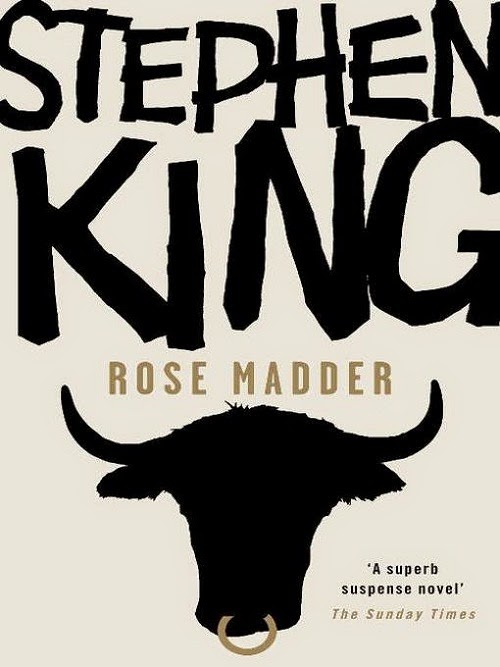
Rose Madder


        During the Nineties, there was a phase Stephen King went through. It might have been a convergence of various factors, it could have just been that certain dangerous habits were instead replaced by a certain amount of mysticism and an interest in telling stories about abused women after he'd essentially put his wife through the emotional wringer with said dangerous habits. Either way, it resulted in a series of loosely-connected novels involving abusive and just asshole husbands known colloquially as "The Abused Wife Trilogy". The first two of these books were more closely connected, with Gerald's Game having a strange empathic link with Dolores Claiborne. The third, Rose Madder, is more closely linked in theme than in any other way, and doesn't appear to have anything to do with the solar eclipse. At best, it's a Lifetime movie someone devised whilst on hallucinogens,

Rose Madder is also Stephen King's weakest book, barring maybe The Tommyknockers

                             Certainly one of the weakest I've ever read. This may be under bias, as I had the damn thing for well over nine years without reading it (I picked it up with a few others, including Christine, the fate of which is still left merely to my imagination. I think I gave it away)

                         Now, this is not to say it's a bad book. King can still tell a good story even on a bad day. Needful Things proved that just last week. But it's weak. Compared to the literary canon of King, including books that made me think more about the world I lived in and the interconnectedness of everything in the universe (Yes, The Dark Tower is what first got me interested in Taoism. Shut up.), made me afraid of bathrooms for the duration of my reading (It), and swear off reading any of his short stories ever again (Night Shift, and it didn't last, because Skeleton Crew and Nightmares and Dreamscapes are full of awesome shorts), Rose Madder comes up surprisingly short. If this is your introduction to King, it might be worth a read. If it's something you get out of the library on a whim, sure. Go ahead. If you want my copy of the book, and have something to trade, I might consider it, though I'd feel like you were being robbed. But honestly? Borrow this. Please don't buy it. It's a good book, but there are better out there.

More, as always, below.

Sunday, October 5, 2014

Needful Things


            We, all of us, have some crap in our lives. I could refer to it as something stronger or something weaker, but no. Crap is the word for it, crap is what it is, crap is what we say to ourselves when we realize that we've lucked into more of it. It is, was, and will be, crap. Worse yet, this crap takes a long time to work through. And crap has many different varieties. There's simple crap, complex crap, mental crap, emotional crap, physical crap...all different kinds. Because it takes a long time to work through, and because that time is a horrible slog filled with diversions as we try to make ourselves happy enough to balance out the crap, we find ourselves in some small moments going "Oh, if only there were some way to clear away the crap, some kind of quick fix that would instantly make our lives that much better and give us the security and stability we so need." There isn't, sometimes it'll take years, I'm still plagued by the crap from almost three years ago, and there's crap going back even further than that, crap I'll probably never be over. But still. If only there were a way to clear the crap. If only there were something to remove the clouds, to get the fog to clear...wouldn't you give anything to take the shortcut?

And this, dear reader, brings us to this week's selection and the start of Stephen King Month, Needful Things

                               Because Needful Things is about a town that's offered a chance to get rid of their crap with a little help from a friendly shopkeeper. The easy way out. All for the price of whatever they think it's worth, plus a little extra "good deed" for Mr. Leland Gaunt. It's a book about doing recovery the hard way, and how easy it is to take the quick solutions out. It's a small-town morality play narrated by a deranged version of the Stage Manager from Our Town who has decided that the people of his tiny small town need to learn some important lessons and also burn down. 

                              And...well, it's not brilliant, or great, or even something I'd describe as good. But despite its numerous flaws, when Needful Things is on, it is very, very on. If nothing else, it's a curiosity with some interesting characters and a cool central premise and some interesting meditations, but not something I could wholly recommend picking up. Give it a read if you're curious, but it's entirely nonessential. 

More, as always, below. 

Monday, September 15, 2014

Pollen


John Barleycorn must die...
                         

                           Allow me to discuss the nature of a series of books. A series is a very careful thing. Especially when escalation is involved. It's fine to do sequels for the books, or even have to break up one book into a trilogy. But when writing a volume that is something of the conclusion to the whole mess, there are two very specific guidelines: First, that the book actually make some kind of sense, and second, that it actually concludes things in proper order, not some incredibly hallucinatory sequences that make the whole thing feel like some kind of horrid sideshow where the main plot isn't ever involved. 

                             Now, as Pollen stands alone, it doesn't necessarily have to follow these two guidelines. In fact, it's entirely free from these two guidelines, because it takes an entirely new story in the same universe, with entirely new characters. But in following the escalation patterns on from Vurt and presenting a world where the bleed-through between reality and Vurtuality has reached critical mass, Pollen's job would be to explore the bleed-through and conclude with some kind of cohesion. Instead, in telling its story, it gets too into the hallucinatory nature of the events, completely ignoring a cohesive story at certain points for an abstract and kind of aggressive surreality, culminating in a game of hot-potato with a black beetle representing groundedness in reality, and something of an anticlimax. 

But there's more than enough rope Pollen is giving me. Why am I having trouble? 

More, as always, below.

Sunday, September 7, 2014

Vurt

                 
"A young boy puts a feather in his mouth..."

                      I found this book at random, which, for some reason, makes sense. It just feels right that my first introduction to Jeff Noon would be at completely random, a completely accidental collision with the insane genius behind...well, Jeff Noon books, as Noon lacks a genre he can be pigeonholed into other than maybe, say, science fiction. And since at its core Vurt is about a bizarre, sometimes macabre, often tragic series of accidents, it makes sense that while looking for another book whose name was lost to me I somehow stumbled upon a brightly colored book. The book's spine read, in descending order, "JEFF NOON - VURT - Crown", and at first I thought it had to be a pen name. I also hadn't seen a book this brightly colored before. Intrigued, I took it to the desk, figuring if I was about to read something tawdry or mundane, at least it was tawdry, mundane, and trying to be interesting in some respect. 

                          By the time I was walking home, I'd opened the book and found...well, a bizarre mix of abstract visuals, Irvine Welsh-style grit, well-disguised gnosticism, slang, and the feeling that one has left an electronic dub soundtrack on and one does not know where. The first chapter alone whiplashed between mood, tone, and sometimes even genre at dizzying speeds. After that, the book swirled into a rabbit hole of horror, black comedy, and what's best described as "post-cyberpunk" if it could be pigeonholed into a genre at all. By a third of the way through the book, I found it weird but engaging. By two-thirds, bizarre and a little uncomfortable. And by the end? Well, I'll leave that up to you. Suffice it to say, the book may be ten shades of cracked-out-- and it is-- but it's well worth a read, and one of those books that I've wanted to own for years but simply haven't gotten the chance. I heartily recommend you own this book. In fact, if you don't have another tab open to Amazon looking for a good edition of this right now, I strongly suggest you do.

Why? Well, read on...


Sunday, August 3, 2014

Preacher


                           The first time I'd ever heard of Preacher, I didn't know what to think. It was described to me as "A preacher, his gun-toting ex-girlfriend, and an alcoholic Irish vampire set out to find an absent God". That didn't exactly light a fire under me to read it, no matter how highly it was praised by The Year's Best Fantasy and Horror for that year, nor how it was doing in the numerous comics publications that got the word out about Garth Ennis and Steve Dillon's lurid and highly mature American heroic epic (very well, despite the backlash Garth Ennis now enjoys for writing lurid and highly mature works). It just sounded kind of...well, not quite my thing. So I let it go until two years later the brilliant minds of Bill Barnes and Gene Ambaum brought it up in their well worth the read webcomic Unshelved. Then, because I'd had multiple sources confirm that yes, this was worth reading, I fired up the Inter-Library Loan client at Maplewood Library, and...

                          ...promptly looked at the sheer number of books and trades and side-stories, and promptly ordered Sandman, because at least I knew where to begin with that. It wasn't until years later where, jaded into apathy by Joss Whedon's utterly depressing run on Astonishing X-Men, I wandered into a comic book store looking for a pre-screening ticket to Grindhouse and decided (being completely flat-out skint) to talk comics with the guy at the counter while my friends browsed around the store. When he mentioned Preacher, I said something dismissive about that I didn't really feel like reading about a minister, only for him to jump in with "with the Voice Of God! He's a preacher with the voice of God!" And now that I knew that, the comic became intriguing. I wondered how anyone could get sixty-eight issues out of a preacher with the voice of God travelling around to find his creator when He abandoned the throne. So I looked into it, and what I found...

                  What I found blew me away. I have yet to encounter something like Preacher before or since-- a loud, brazen assault on the senses; a tale of a world gone mad in the absence of its creator, and the bluntest solution to the problem of theodicy I have ever seen. And yet...there's a softness to it. A humanity. These are people trying their hardest to put the world back together in spite of forces literally beyond their control. And for this reason-- as well as others-- it is one of the best comics I've ever read before or since. And I will defend it beyond reason and sense, tooth and nail, because of this. It's nasty, insane, brutal, lurid, and at the same time incredibly touching in its own way. It's vulgar, but with a heart. And I love it. Read this. Or try to. It'll probably be too graphic and sick for most people, but if you can see past this, there is a book with a lot of heart and a lot of heavy subjects in here. 

More, as always, below.

Tuesday, April 29, 2014

Shadowland


"Long ago, when we all lived in the forest..."

                And Peter Straub Month is brought to a smashing close with Shadowland. There is one sentence I can use to describe this book, one that I'm surprised I'm using, but one that makes perfect sense:

Shadowland is what would happen if Lev Grossman hadn't failed when he wrote The Magicians

                  Now, that's a bold statement. And as a bold statement, it deserves some backing up, so here goes: With Shadowland, Peter Straub takes a few traditional concepts-- children growing up, an elderly magician teaching young people real magic, an enchanted forest visited by the young where the rules of reality don't exactly apply, and all the other conventions of things young adult fantasy novels love to use-- and he twists them around. Where he succeeds is that he never once condescends to the reader or blatantly disrespects them. He just shows them a new perspective on what they know, almost as if having a discussion of it. Shadowland begins pretty dark, that's a certainty, but most of the novels it's riffing on do as well. The difference is that the other novels do get somewhat lighter. The danger seems like it comes from outside the world, not from within. And that is where Shadowland differs. Because in Shadowland, the danger seems like it might come from within, too. Even the rules of magic sound fairly sinister, including such items as "The physical world is a bauble". But just why is it worth reading Shadowland, and why does it stand tall against all comers? 

Well, read on...

Saturday, April 19, 2014

Ghost Story


     "What's the worst thing you've ever done?"
"Well, I won't tell you that-- but I will tell you the worst thing that's ever happened to me...The most dreadful thing..."

                      Imagine a glass of water. Now imagine someone comes by every half-minute or so and drops a marble into that glass of water. Now, because we're imagining, imagine the lights in wherever you are are timed to drop lower as the glass fills with marbles, and when it overfills, you have the feeling something very bad is going to happen. Plink. Plink. Plink. Each marble driving you closer to some kind of unnerving, unsettling catharsis.

This is what it's like reading Ghost Story

                     I could talk about how it pays homage to the tradition of Gothic novels, how the unsettling nature of sexuality and guilt play a part in the work, but honestly, that's where I want to start. The marbles. The catharsis. Because that's the elegant part. Ghost Story is a brilliant book, a one-of-a-kind book, because it above so many other novels of its type understands subtlety and atmosphere. The book is permeated by it, but offers certain enticing and readable qualities that set it slightly above its drier predecessors. It's not a tight story, but what it lacks in tightness and tension it more than makes up in sheer atmospheric dread and richness of setting. Ghost Story nests its stories, adds stories to the overall framework, and all of it is a brilliant, if unsettling and chilling read. If ever there were a book worth tracking down, worth finding and reading voraciously, this is it

More, as always, below. 

Sunday, April 13, 2014

Koko


"So what's it like to kill someone?"
"I can't tell you."
- Unnamed Cabbie and Michael Poole

                  
                   Koko is brutal. It is, perhaps, the most disturbing and uncomfortable book I have ever had the "pleasure" of reading. I phrase it that way because I can acknowledge that the book is well-written, that Peter Straub has an amazing turn of phrase, and that there is a brilliant thread at work here. But what Straub manages to do with Koko is to explore the feelings of trauma, guilt, and psychological suffering felt by its protagonists, to take you inside their heads, and to allow you to identify with them. You yourself may never know the trauma or never know what trauma does to people, but for the time it will take you to read this book, this uncompromising and singleminded work of fiction, the feelings will at least be right. I could not read this book all at once. I may never read it ever again. But hopefully, if you find this and read it, and if you find in it the same things I did, it will leave its mark on you. And that, above all else, is what defines a successful work of literature. If you're never able to shake the feelings it gives you, it's won. It's done its job. 

                I admit when I first started reading Koko, I was turned off by it. The copy on the dust jacket was utterly ridiculous to me after reading so many books that made the same claims. I knew off the bat that this would probably be more psychological thriller than horror novel and started looking for the proper cues to tell me who the murderer truly was. I even complained about how the characters missed an obvious clue about the villain a third of the way through the book. But as I read, I started to see where it was going. I wondered where it would all end up and how. And then when I figured out what the book was really about, the pieces suddenly clicked into place and what I saw as disparate, offhand elements suddenly came together and clicked. Koko, you see, is not a book about four men, or a book about a serial killer, or even a book about the frightening underbelly of urban legends in southeast Asia. It's a book about trauma, guilt, pain, and exactly how far you can push the human psyche until it snaps. 

And it is brilliant.

More, as always, below

Saturday, March 15, 2014

The Rook

   
                 Okay, so the rundown is as follows: The Rook by Daniel O'Malley may not be a great titanic work of literature, but it is fun. The dialogue is witty, the detail is in overload mode, the creatures are frightening, and it's one of the few books with sentient religious fungus that I can also describe as "a hilarious read". And for a first novel, while it shows the wear and inexperience of its author, it's one hell of a debut. 

                  The bad is a few pacing issues, a tendency to over-info-dump while simultaneously delivering loads of detail, and the fact that there are loose ends to be tied up and the falling action seems to be setting up a sequel. 

                  But all in all, I suggest finding this book, taking possession of it, and clearing space on both your shelves and in your weekend for it, because if nothing else, it's too interesting a ride to pass up.

More, as always, below.

Monday, February 17, 2014

Nocturnal


                           Okay, so the rundown is as follows: Nocturnal is a book with a lot of cool ideas. It follows Inspector Bryan Clauser and his partner Pookie Chang as they chase down cults, conspiracies, and serial-killing monsters in the streets of San Francisco. The last two hundred pages are a powerhouse of a ride, and a lot of the twists are well-built and not telegraphed. Scott Sigler knows what he's doing, and when it shines through, it shines. The characters' chemistry and some humor from the hunter of the supernatural not knowing exactly what he's doing also lend itself to some good scenes.

                                The problem is that there are three hundred pages before that, a lot of which tends to feel kind of like bloat and slows the momentum down a little, when Sigler's at his best with the throttle wide open and the plots breathless. The other major problem is that the main character is very hard to connect to, and that the plot feels kind of more built from conveniences than logical conclusions, and there are a lot of leaps. 

                                  But in the end, despite its flaws, I highly recommend looking into Scott Sigler's books, and if you happen to find it on the library shelf, go ahead and give Nocturnal a try. You may find you like it more than I do. I just wouldn't recommend buying it. 

More, as always, below.


Saturday, February 8, 2014

Hell's Horizon


            Okay, so the rundown is as follows. Hell's Horizon is a damn good detective story. It's a creepy mystery novel full of the surreal horror and unnerving violence that marked its predecessor. The dialogue and atmosphere are top-notch, and even if you can guess some of the plot twists before they hit, the way they're presented makes them feel newer and fresher. 

                     Unfortunately, if you're squeamish, this is not the book for you. When the violence comes, it comes in loving detail and some truly grisly scenes. 

                          But in the end, I highly recommend this one. Both as part of the City Trilogy and as a book on its own. Please do check it out. 

More as always below.

Saturday, January 11, 2014

Procession of the Dead


      Okay, so the rundown is as follows: Procession of the Dead by Darren Shan is a brilliant, brutal, twisted crime story set in a massive nameless city full of green fog, strange characters, and enigmatic plots. The story follows the rise of Capac Raimi, a small-time gangster in The City who is taken under the wing of The Cardinal, an eccentric crime lord with an interest in fate, puppets, progress, and possibly world domination. 

               The book is strongest when talking about the city, with vivid descriptions backing up the insane cast and rapid dialogue. In particular, the characters of Conchita and Paucar Wami are excellently done, though The Cardinal deserves a special place for being convincing even at his most unhinged (and he gets pretty unhinged). 

                 But the book is weakest with a climax that more stops than ends, and ties everything up into a bow that wasn't completely needed. Furthermore, the main character's weird mood and behavioral swings, while they make sense given the trajectory of the book, are just a little distracting. 

                  This does not stop the book from being incredibly high-quality. Anyone who enjoys a good mystery and can get past the violence and general weirdness of the premise is strongly suggested to buy this and start reading immediately. 

More, as always, below.