Saturday, July 7, 2012

Empire State


"You're late."
"No, actually, you're early." He rechecked his watch. "Actually, I am late, I think my watch is busted."
"Like your lip."
- Rad Bradley and Kane Fortuna
       
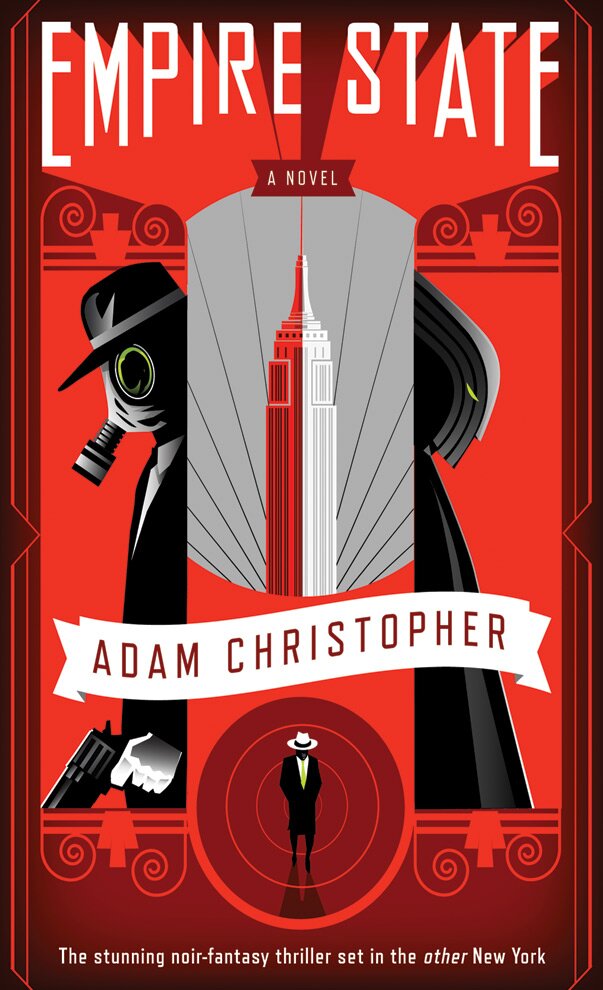
        I found this book in a very conventional way, for once. It was on the shelves of the local Barnes & Noble not far from my house. Now, I don't normally support big bookstores, but they've never steered me wrong much. In fact, a lot of the ones I visit inexplicably have smaller and mid-range press genre titles sitting on the shelves without the slightest provocation*. I'd had a bad day, and some money burning a hole in my pocket, so I pointed myself towards the bookstore. And there the book was, its cover done in a very stark red-black-white-green Art Deco-style design, and its back promising a story of private detectives, film-noir backdrops, and masked villains. I was intrigued, and by the time it started to compare itself to Boardwalk Empire and Batman, I knew it would make the trip home with me. 
           And at first, it was brilliant. That was at first. As the book continued, it started to cool off a little, turning into something more and more...off. And eventually, I found myself realizing the thing I always realize...a lot of the modern retro-future writing aims high...and then promptly ducks under the bar. There are exceptions, of course...Stephen Hunt's lightly retro-themed fantasies are a delight, Larklight is a great book with an interesting atmosphere, and the seminal works of the genre-- like K.W. Jeter's Infernal Devices-- are, while flawed, classics in their own right. But it seems now that every pen jockey with something to prove has to say it with pneumatic tubes and an over-gross of airships. 


But that's enough of that. 


             Empire State is the story of private detective Rad Bradley, a man who doesn't seem terribly in his element. Rad lives in the Empire State, a fog-enshrouded version of New York City, and is given a case to find Samantha Saturn, a woman who has gone missing after an encounter with the quietly-sinister Pastor of Lost Souls. Rad is also menaced by two men in gas masks asking him about "Nineteen Fifty" and hounded by a long-dead superhero named The Skyguard. Rad must decipher the clues about the city and keep one step ahead of his enemies if he ever hopes to unravel exactly what is going on in his city and indeed why it even exists. As things ramp up, he will encounter cyborgs, doppelgangers, alternate universes, and the possibility that his own friends may know more than they let on. Much more than one could ever think of. In the end, he may have to contend with the end of the world if he hopes to solve the case and save his own universe from destruction at the unwitting hands of our own world.
            And I would like to tell you it's the book that revived my faith in the genre. I'd like to tell you it's the book that I could hold aloft as proof that the retro-future genre isn't a complete wash. 


Yeah. I'd like to. But you already know how this review is gonna go. 


              Empire State is above all a book with serious commitment issues. It wants very badly to be a golden-age superhero story. It also wants very badly to be an alternate-world story (spoilers be damned, it's right there on the back of the freaking book), a noir detective story, a retro-future sci-fi novel, and a pulp adventure story. It wants to be all these things and it tries really, really hard to be all of them. The problem is, since it can't make up its mind and it cannot be all of these things, it really just falls short of all of it. The book ends up a jangling, confused mess where people swap allegiances almost with the flip of a coin and a major character is named "Nimrod" for seemingly no purpose than to hold up the naming conventions. The ending makes no sense, as not even the main character can tell whose side he's on and what he's doing in the overall conflict. 
              That sense of not really knowing what's going on permeates the entire book, too. Perhaps it's just that I failed to connect with the plot on any level, but it just didn't seem like there was any reason for me to. The initial chapters did much to try and draw me in, but once I was there; the story got bored, puttered around the house, checked its email, and then promptly looked back into the living room where I was sitting and asked, "Oh, you're still here?" When the few historical characters used (there are two of them at the very least, I know, shocker) appear, they're given some brief context as to who they are, but not really much to why they're there. The main villain of the piece is one of those, further driving any investment in the plot towards apathy.
               Speaking of the characters that drive the main plot, there are four of them. None of them are the main character. Not a single one. And this is the problem. There are books where the protagonists have had no effect on the plot. Gravity's Rainbow is a good example of a book where the main character has no real effect on the plot, and Gravity's Rainbow, despite being the most incoherent and cack-handed book ever written, is a fantastic read**. But to have us follow a single character from cohesive beginnings to an incoherent climax that involves Rad, his alternate universe double (spoilers be damned, if there's an alternate universe, there is always an alternate universe double. This is a scientific fact), his introduced-as-untrustworthy ballroom-dancer friend, and just about every other high-powered character in the story. It eventually rockets towards a climax that, somehow, The Strange Affair of Spring-Heeled Jack handled better***.
                However, after all of that, I do have to say this: The book has its good points. A fair number of them. The bits in the Empire State reveal a pulp dystopia**** that sounds like a lot of fun to play around in, and there is an excellent control over setting. At the beginning, the mystery is gripping and reads very well, unfolding with just the right amount of information to keep you guessing. I admit that this is one of the very few works of fiction that had me stumped: I had no idea where they were going with the story (I would later learn this is because the story went nowhere), and I liked that. And the dialogue, on top of all those things, is very well-done. Maybe not to Locke Lamora levels, but very well done nonetheless.
                But in conclusion, it is the plot that keeps the book down, and the plot that damns it. Despite having a great many cool concepts in it, the book isn't actually about anything, and without any kind of driving force behind it, the machinery breaks down, and that big, beautiful box of a plot unfolds into a depressing Christmas present, much like an ugly sweater but with more robots and gunplay.The issue Mr. Christopher has in his book is the same one I have with my own writing-- you can invent as many cool concepts and characters and lines as your mind can dream of, but it doesn't mean a thing if you can't give them anything to do.
                And so my final verdict would be this: While I don't recommend this book, it's certainly not terrible enough to warn you away from it (Hello to Ghosts of Manhattan!). I'd suggest taking it out from the library if you're curious, and seeing how you fare. It's certainly an interesting novel, if not a particularly well-plotted one. 


Next Week: A new classic of literature with Broken Piano for President


*It's weird, but then again I live in New Jersey. Weird kinds of things (like, f'rinstance, Eraserhead Press books sitting on the shelves of Barnes & Noble) just sort of happen statewide. My unofficial state motto is "Over sixteen portals to hell and counting!"


**As a sidenote, I hate this book even more for making me use up a Pynchon reference before I did a review of an actual Pynchon book.


***Actually, in hindsight, I may have been a little too hard on Burton & Swinburne. Despite the stupid time-travel bits, it's actually quite well-constructed compared to other books in the retro-future genre.


****This word is not recognized by my spellcheck, but somehow "Quidditch" is. Why is it not recognized by my spellcheck?!

Friday, June 29, 2012

Test Pattern

This is a test pattern to try out new font colors for the Blogger version of this blog


This is a test pattern to try out new font colors for the Blogger version of this blog


This is a test pattern to try out new font colors for the Blogger version of this blog


This is a test pattern to try out new font colors for the Blogger version of this blog


This is a test pattern to try out new font colors for the Blogger version of this blog


This is a test pattern to try out new font colors for the Blogger version of this blog


This is a test pattern to try out new font colors for the Blogger version of this blog


This is a test pattern to try out new font colors for the Blogger version of this blog

Tuesday, April 17, 2012

Original Work: Now Somewhere Else!

                   So I've decided to do something kind of interesting. I'm going to be blogging my project The Becksdale Archaeology over here.


The project is a sort of "fake true ghost stories/local legends" collection...think something like this, only I've made all the stories up, and they take place in the small town of Becksdale, NJ.


Why NJ? Because it's such a supernatural focal point it's hard not to set a book there. Also, most people write what they know, and I do know the small town of Metuchen NJ. As well as having taken many eerie-looking photographs of Metuchen, NJ At least in its fictional version based on real landmarks and photos I've taken. It's experimental, and as part of it, I have to write most of it as "nonfiction", to help keep the "immersion" when this is actually gonna be published. So here's the copy:


The small town of Becksdale, NJ has more than a few local secrets. People feel like they're being watched in the woods behind the town. The town's bike path, labelled the "Greenway", has been left mostly abandoned and overgrown for unexplained reasons. A man appears and vanishes every night at the local veteran's grove, placing a wreath under a specific tree. Join the Becksdale Historical Society and paranormal enthusiast Sam Reader* as they explore the local legends and unusual historical treasures of our small town, in a book that is sure to chill and delight**.


And of course there will be ongoing threads and whatnot. I just figure if I write it for my audience (all two of you), I'll keep going at it, and with the schedule, it'll get easier. In essence, treat it like a blog, and I'll act like it's a responsibility.


So. Hope you enjoy, and I'm proud to announce I may be getting off my ass. Watch this space and that space.


*Just to break fourth wall here. Since it's probably going to be my name on the damn thing, I might as well use my name as the main character
** Since we're spoofing the genre, why not spoof the ad copy, too?

Monday, April 16, 2012

The Grand Unveilling: Taste by Kate Evangelista


Ladies and gentlemen, today I have something new and unprecedented. It’s really cool that I’m able to do this, because I definitely don’t do it often, and I may never get the chance again. 

So, let me get the first part out of the way: 

New for you and coming out soon, the new novel from my wonderful and very worthy of your time colleague Kate EvangelistaTaste! Trailer below, with the song “Hunger” by the very talented Noelle Pico*. There’s also a hidden link somewhere in this post. Do be on the lookout.


As you have no doubt guessed from the cover, this is not the usual kind of thing I do. This should give you all the more reason to read it, because just based on the excerpt (which will be posted and dissected below), I definitely think it’s worth a read. Why? Because the author knows what she’s doing, she actually got me interested in a book in the supernatural/urban fantasy genre that wasn’t written by Richard Kadrey or Simon R. Green, and overall, she’s someone who I am truly pleased to know.
But I’m talking too much here. Please, for your own edification, an excerpt where the heroine, Phoenix McKay is accosted by the fearsome Night Students:

I mentally stomped on the intimidation their perfection brought into my mind and said, “Excuse me.”
The group froze, startled by my words. The girls had their brows raised and the boys stopped mid-speech, mouths agape. They stared at me with eyes the shade of onyx stones.
I smiled and gave them a little wave.
The boy a step ahead of the rest recovered first. His stunning features went from shocked surprise to intense interest. He reminded me of a hawk eyeing its prey. I gulped.
“A Day Student,” he said, his eyes insolent and excited.
Something about the way he said “Day Student” made my stomach flip. “Excuse me?”
They snickered. The boys looked at each other while the girls continued to stare, muffling their laughter by delicate hands. I seemed to be the butt of some joke. 
“You broke the rule.” The boy’s grin turned predatory.
The students formed a loose semi-circle in front of me. My gaze darted from face to face. Hunger filled their eyes. The image of lions about to chase down a gazelle came to mind. I mentally shook my head. I was in the mountains not the Serengeti for crying out loud.
I took a small step back and cleared my throat. “Can any of you give me a ride back to the dorms?”
The boy wagged his forefinger like a metronome. “Ah, that’s unfortunate for you.”
One of the girls pinched the bridge of her nose. “Eli, you can’t possibly—”
“It’s forbidden, Eli,” another boy interrupted, pronouncing the word “forbidden” like a curse.
The nervous murmur at the pit of my stomach grew louder. Six against one. Not good odds. Instinct told me to cut my losses and run. Bad enough I faced expulsion, now it seemed like weird, beautiful people who’d suddenly appeared on campus wanted to beat me up. No, scratch that. Judging from the way they studied me, beating me up wouldn’t satisfy them. Something more primal prowled behind their looks.
I definitely wasn’t going down without a fight. Years of self-defense and hand-to-hand combat classes had me prepared. While other children from rich and important families got bodyguards, I got defense training. But I think my father meant for my skills to go up against potential kidnappers, not against other students who may or may not be crazy. Oh God! Maybe I stepped into a parallel universe or something when I reentered Barinkoff.
“None of the students are supposed to be on campus,” I said. Then, realizing my mistake, I added, “Okay, I know I’m not supposed to be here either. If one of you gives me a ride back to the dorms, I won’t say anything about all this. Let’s pretend this never happened. I didn’t see you, you didn’t see me.”
“We’re not ordinary students,” Eli answered. “We’re the Night Students.”
He’d said “Night Students” like the words were capitalized. I didn’t know Barinkoff held classes at night. What was going on here?
Eli smiled with just one side of his mouth and said to the group, “She’s right, no one will have to know. We’re the only ones here. And it’s been so long, don’t you agree?”
The rest of them nodded reluctantly.
“What’s been so long?” I challenged. I fisted my hands, ready to put them up if any of them so much as twitched my way.
“Since the taste of real flesh passed through my lips,” Eli said. He came forward and took a whiff of me then laughed when I cringed.
“Flesh.” Yep, parallel universe.
“Yes,” he said. “And yours smells so fresh.”
Someone grabbed my shoulders from behind and yanked me back before I could wrap my mind around the meaning behind Eli’s words. In a blink, I found myself behind someone tall. Someone really tall. And quite broad. And very male.
I realized he wore the same clothes Eli and the other boys did. Not good. He was one of them. Although… I cocked my head, raking my gaze over him. He seemed born to wear the uniform, like he was the pattern everyone else was cut from. My eyes wandered to long, layered, blue-black hair tied at the nape by a silk ribbon. Even in dim light, his hair possessed a sheen akin to mercury.
I looked down. The boy’s long fingers were wrapped around my wrist like a cuff. His fevered touch felt hotter than human standards, hot enough to make me sweat like I was standing beside a radiator but not hot enough to burn.
“I must be mistaken, Eli,” the boy who held my arm said in a monotone. “Correct me. Did I hear you say you wanted to taste the flesh of this girl?”
A hush descended on us. It had the hairs at the back of my neck rising. How was it possible for the atmosphere to switch from threatening to dangerous? Unable to help myself, I peeked around the new guy’s bulk. Eli and his friends bowed. They all had their right hands on their chests.
“Demitri, I’m sure you misheard me,” Eli said.
So the guy standing between me and the person who said he’d wanted to taste me was named Demitri. I like the sound of his name. Demitri. So strong, yet rolls off the tongue. Definite yum factor.
“So, you imply I made a mistake?” Demitri demanded.
“No!” Eli lifted his gaze. “I did no such thing. I simply wanted to show the girl the consequences of breaking curfew.”
“Hey!” I yelled. “Don’t talk about me like I’m not here!”
Demitri ignored my protest and continued to address Eli. “So, you threatened to taste her flesh.” His fingers tightened their grip around my wrist. “In the interest of investigating this matter further, I invoke the Silence.”
All six students gasped, passing surprised glances at one another.
Before I could ask about what was going on, Demitri yanked me down the hall toward the library. But why there? Oh, maybe we were getting my things. No, wait, he couldn’t have known about that. Everything was too confusing now.
Eli and the others didn’t try to stop us when we passed them. Demitri’s cold command must have carried power. Handsome and powerful, never a bad combination on a guy.
We reached the heavy double doors in seconds. He jerked one open effortlessly. I’d needed all my strength just to squeeze through that same door earlier. To him, the thick wood might as well have been cardboard. I raised an eyebrow and mentally listed the benefits of going to gym class.
“Why are we here?” I asked after my curiosity overpowered my worry. I’d almost forgotten how frightened I’d been right before Demitri showed up. I wasn’t above accepting help from strangers. Especially from gorgeous dark-haired strangers with hot hands and wide shoulders.
Demitri kept going, tugging me along, snaking his way deeper into the library. I had to take two steps for every stride his legs made. I tried to stay directly behind him, praying we didn’t slam into anything.
He stopped suddenly and I collided with him. It felt like slamming into a wall.
“Hey,” I said, momentarily stunned. “A little warning would be nice!”
He faced me, and I gasped. His eyes resembled a starless night, deep and endless. Their intensity drilled through me without pity, seeming to expose all my secrets. I felt naked and flustered beneath his gaze.
“You could have died back there,” he warned.
A lump of panic rebuilt itself in my throat.

So immediately we have a conflict between a group of beautiful-but-cruel um…students, and our main character. I like the feel of this conversation, that it’s similar to other novels, but doesn’t play up the helplessness and impulse first thing. In the interest of objectivity, I do have to say that the prose is a little too purple for me, but I like it enough.

And finally, no unveilling would be complete without the author:


When Kate Evangelista was told she had a knack for writing stories, she did the next best thing: entered medical school. After realizing she wasn't going to be the next Doogie Howser, M.D., Kate wandered into the Literature department of her university and never looked back. Today, she is in possession of a piece of paper that says to the world she owns a Literature degree. To make matters worse, she took Master's courses in creative writing. In the end, she realized to be a writer, none of what she had mattered. What really mattered? Writing. Plain and simple, honest to God, sitting in front of her computer, writing. Today, she has four completed Young Adult novels.

And you may contact her here:
Author Website: www.kateevangelista.com
Twitter: @KateEvangelista
Crescent Moon Press page for Taste: http://crescentmoonpress.com/books/Taste.html

So there you have it. A really cool book, a fantastic author, and my first grand unveilling. Congratulations, Kate!


Friday, February 24, 2012

Clans of the Alphane Moon


"Psychosis is psychosis", said Lord Running Clam, "And a fanatic is not to be trusted."

         I was going to give you a post on Empire State, and to do this the time after that. But this was too good to pass up. See, I've wanted to read this for years and never got around to it, and now that I have, I'm very glad I did. Because it's not the book I first thought it was. It's much better than that book.
       
       So this actually starts with my dad again, like most of my early forays into genre fiction. He's the one who first read me The Hobbit, with its illustrations by Michael Hague. He's also the one who steered me away from most of the books that I wouldn't have got as much when I was younger, and then recommended I read them when I was older. In fact, a lot of my taste in books comes initially from him. It grew and mutated out of that, getting both crazier and a little bit saner, but overall, this blog wouldn't exist if it weren't for him reading to (and telling stories to) a confused little kid and then helping him seek out more of the same.

And, through this book, he was also my first introduction to Philip K. Dick.

    I found the book, like most of the books he turned me on to, on the bookcase in his office. He had a whole mess of mass-market science fiction paperbacks on those shelves, and nestled in between two novels whose names have been lost to time immemorial was a thin gray book with a picture of a strange yellow alien on it, the generic sci-fi type reading Clans of the Alphane Moon*. While at the time I was too young, I remembered it, and later on, when I was in my heavy metaphysical/literary phase**, my dad said that I might find the book entertaining and cited a rant by one of the characters on how everything seems interconnected and planned. Unfortunately, at the time we had misplaced the copy of the book, and when I found it, I was hard in the grip of several interlibrary loans and didn't feel like I had time for it, so it languished in a drawer. 

      Years later, when I went to Hawaii to study librarianism (sadly back-burnering you, Dear Readers****, in the process), I got a job in the reference department and as fate (or indeed synchronicity) would have it, Clans of the Alphane Moon was the first book I found in the literature section. I grabbed it and took it out right on the spot. And it is entertaining, though it is also much, much more.

     Clans of the Alphane Moon tells the story of Chuck Rittersdorf, a CIA roboticist tasked with operating and writing code for propaganda androids in Communist countries, said countries meaning everything that isn't the United States of America. His wife-- a cold, businesslike borderline psychotic named Mary-- has just started a ruthless divorce campaign to take his house, his money, and his children away from him. He now lives in an apartment building with a meddling-yet-well meaning Ganymedean slime mold named Lord Running Clam and tries to stave off thoughts of suicide with a slowly-evolving plan to kill his wife via android while she's on a science mission to the titular moon, Alpha II M3. 

And then things get weird.

        Alpha II M3 is a former mental hospital-cum-penal colony where the Terran influence collapsed and the psychotics organized themselves into clans based on their mental disorders: Manics, Paranoids, Schizophrenics, Depressives, Hebephrenics, Obsessive-Compulsives, and Polymorphics. Mary, a psychologist, is there to evaluate them and try to bring the colony back under Terran control before things get out of hand. They're especially interested in the Manics, as their mania is resulting in highly-advanced technology, and the Paranoids (or Pares), who overanalyze everything to the degree of setting up meticulous political systems and tactical plans. 

       Meanwhile, on Alpha II M3 itself, the clans are convinced that Earth is watching them, ready to attack at any moment. They're insane, heavily armed thanks to the Manic clan, and they aren't going to be re-institutionalized by their former masters without inflicting heavy casualties. They are aided by schizophrenic "Prophets" and "Saints" whose delusions are augmented by actual psychic powers and precognitive abilities. And worst of all, they're all absolutely right.

      All of this, along with a TV comedian who has a hidden agenda and a group of Alphane weapon dealers in his pocket, is about to collide in what could be a highly probable bloodbath all over the moon. 

And if you couldn't tell from that plot description, Dear Readers, it's a comedy. And a particularly funny one at that. No, I'm not making this up. 

   It is also one of the best books I've read this year, hands down. Dick has always handled characters and irrationality the best out of anyone, so a Philip K. Dick book about irrational characters is already getting a running head start. But it's the way he makes everything sound so sane, from a moon ruled by a caste system of psychotics to a slime mold who can't help but resort to telepathy and blackmail to fix someone's life. You never start to question the machinery that runs the book, as Rittersdorf is such a believable schlub and everyone around him plays out as if they have their own self-interests, but they all go through Rittersdorf, thus making him important and also showing why. The character interactions also do a great deal in making the central characters (Rittersdorf and Running Clam) the most sympathetic in the book, as they are the only two people not trying to use anyone or manipulate the situation. It got to the point where, as I was reading it, I'd become so attached to one character that when they died, I actually cried "Noooo!" out loud. The death was such a shock, and such a sudden thing, that it managed to generate pathos without any hint of tawdry emotional manipulation.

    Another reason the book is much better than its parts is the pacing. Rittersdorf's adventure doesn't seem to flag until the last few scenes, and even then, it's still urgent enough to keep one interested. While the start is a trifle slow, it soon pitches full-tilt like the first drop on a roller coaster and doesn't stop until it reaches the end. Even when the characters are talking, there's still a tense, nervous, frantic energy. The dialogue, the characters, and even the slower parts of the plot all contribute to the tension and energy of the book. And the slow parts aren't even that slow. When the plot starts to move, it moves, and even the slow parts move at a quick pace. There's a seduction scene in Clans that doesn't even stop, ripping through the action almost as quickly as the participants do the deed itself.

   Furthermore, the dialogue is paced just as fast as the book, and just as sharp as the humor. There are lines in almost every scene that made me smirk, and two scenes that actually made me laugh out loud. I was in a library at the time and on-duty, which was probably not the best place to be, but hey, it gave me something to brighten up my day. This is nothing new, as Dick has always had interesting dialogue, but it's worth a mention because it makes the crazy machinery behind the book work.

   And finally, the underlying themes are actually decent and worth exploring. Dick has a way with writing insane characters, and a way of writing the sane people so that they're just as crazy. It comes as a surprise, and a funny one at that, when one of the characters who has exhibited signs of being from any one of the clans is declared completely normal to everyone's absolute shock. But that isn't the only theme Dick explores. He also deals with depression and loss of stability in one's life through the story of Chuck Rittersdorf and his wife Mary, both of whom feel the impact of loss when they decide to separate and start divorce proceedings. The intimate, wrenching detail and the feeling of helplessness are very true to life, as well as the well-meaning people who try to get them back on track with their lives, only to cause hopeless disarray. 


     But this is a book with flaws, and most notably, the flaws are that when they finally get around to the big showdown on the moon, the pacing finally does flag. It's sad to see it happen, and more to the point, it takes away from the book. While this is a book that thrives on breakneck speed and insane chases, that it slows down near the end in the middle of a tank battle is inexcusable. It is, however, a tiny, tiny flaw. Especially compared to how absolutely brilliant the rest of the book is. Yes, it may have weak points, and it's not the best Philip K. Dick book, but Dick on his worst day (I'm looking at you, VALIS) utterly buries the competition.


     So in the end, should you read it? Of course you should. It may not have the heavy nature of other books, but it's beyond enjoyable, and touches on some very human themes. And it's funny in the wickedest, blackest way possible, managing to laugh at political assassination and suicide as equally as it does the twisted romantic comedy plot surrounding Chuck and Mary Rittersdorf. It's a book that should not be missed, nor dismissed as simply a laugh. And it is arguably one of the best books I've read this academic year. Yes, you should read this book. Yes, you should take it out of the library. I may not go so far as to buy it, but there is nothing like it in fiction, and for that it deserves your scrutiny.


Next time: Caius finally gets around to Empire State, Fool On The Hill, and possibly The Pilo Family Circus, since that review has been sitting in a cloud server somewhere just waiting to be finished.


* See above image. The book does not contain in any form a nude albino woman with a mohawk licking an alien from Alpha Centauri, but the rest of it is pretty bang-on the money.

** Yes, I had a pretentious college student reading phase. It lasted for four or five years and surprisingly did not include Catcher in the Rye, which was required reading in my high school at the time and which every rational person hated to death. It did, however, contain Ulysses, Ayn Rand, Thomas Pynchon, and William S. Burroughs, so it still counts. So there***.

***William S. Burroughs is still really, really cool, though. Thomas Pynchon, too, in certain doses.

**** All three of you


Tuesday, January 31, 2012

11/22/63


   "You're disgusting!"
  True. And sometimes it's such a pleasure.
   - Jake Epping
  
              I have to be honest with you all, Dear Readers, I thought my first Stephen King post on this blog would be a different post entirely. That post would be The Talisman, which I still haven't gotten around to yet. But I should at least let on that Mr. King and I...we go way back.
  
             The first time I encountered Stephen King's writing, I was in middle school. A lot of the girls in my grade (who, surprisingly, I had no interest in...that'd come later when they got better at backbiting) were reading It and Cujo. For me, King was just some trashy horror writer with a lot of work to his name...I'd tried It and been shocked and weirded out by the bathtub suicide in the early chapters but that was all I knew, really. But one afternoon I sat in the town's bookstore shelving copies of books while I waited for a carpool and I hit upon the books that would make me a lifetime fan: The Dark Tower
   
              These weren't the trashy-looking novels people carried to the beach. They weren't the horror novels meant to terrify and to give other people the author's nightmares. They sounded like very, very dark fantasy novels about a cowboy (oh, all right, a gunslinger) trying to find the titular tower. So I decided, being all of ten years old and sure I could handle reading such an adult book, that I was going to read the Dark Tower series. Sadly, I couldn't find the first book, so I had to start with book two, The Drawing of the Three.
My parents didn't agree with me.
  
           Mostly my mother, who played the role of moral veto far more strongly than my father ever did. But either way, within moments of my bringing the book home, it was analyzed, flipped open to a random page, and taken out of reach indefinitely due to a major character abusing heroin. So my dad reached a compromise and said that if he could find a book that was more appropriate, he'd let me read that. The book he found was The Talisman. I instantly fell in love with it, and it's had a place on my bookcase ever since. And eventually Talisman led into more King, and I was a fan. I am a fan. I read my way through his work with a fervor I'd not experienced since my love of conspiracy theories. Which, of course, leads me to11/22/63.
  
           11/22/63 is the story of one Jake Epping, a divorced English teacher who spends his time marking up the essays of GED candidates in a small high school. It is here he reads the essay of one Harry Dunning about the time that changed his life the most: when Harry's father murdered his family with a hammer, almost killing Harry but instead giving him severe brain damage. It is an essay that moves Jake, rocking him to his very core. While he ponders this (as he calls it) "watershed moment", something else happens that turns his life forever on a dime.
And then things get weird.
  
          Jake frequents Al's diner; a trailer where the burgers are cheap, there's still a smoking section, and Al holds sway over an almost-empty establishment he runs practically at cost. One night, Al decides to show Jake a secret of his: In his pantry are a set of stairs that lead to a September day in 1958. Every time you enter, it's like someone hit a reset switch. Every time you leave, only two minutes have elapsed in the real world. And Al very much wants Jake to use it.
  
            Al, you see, has a specific purpose: He's got his own watershed moment to fix. He wants to stop Lee Harvey Oswald from shooting John F. Kennedy. But Al's not as young as Jake, and cancer's starting to take its toll on him, especially after his first attempt-- after his forays into the past, he's now terminally ill. So Jake is enlisted to go back in time and severely change history (he assumes) for the better. Between his need to try and fix Harry Dunning's life and Al's meddling to make sure he quits dragging his heels, Jake embarks off on his quest to make the world a better place.


        But of course, it isn't that easy, and Jake will have to tangle with several major players as well as fighting the past itself if he ever hopes to succeed.


---...---
  
                 The first thing you should know about the book is that it isn't quite Stephen King's usual thing*. It's mainly historical fiction. Yes, Jake is a time traveler and uses this to his advantage, but the book isn't preoccupied with that. It's as much about exploring the past and the social climate as much as it is about Jake and his mission. Make no mistake, all of King's touches are there...the sense that the world is really a lot stranger than anyone gives it credit for, the strange nonsense words with ominous significance...even the call backs to earlier works**.
  
                 But Jake spends a lot of time working out how the past, well, works and less time agonizing over how his part of things are supposed to work. King put a lot of research and time into the novel, and it really shows-- from the first page to the last, you can get immersed in the world, and it helps get you involved in the story. This is a book that needs its immersion, and the amount of detail King manages to cram into every page-- authentic detail, I might add-- really helps out. The pace never seems to drag, and the ideas never really lose their sense of wonder. 
               
                 Another reason to read this book is the tension. You're never sure Jake is going to make it, and that constant sense of tension is kept up through the whole book. As each new plot detail unfolds, it just adds to the suspense like a group of ball-bearings on a wet paper towel. You're sure something is going to give, and each time Jake scrapes by, there's a sense of relief for a few seconds until you remember the book is still going on. And then the tension starts to build again, slowly but surely...
  
               And finally, the characters are all very well-realized. But this is Stephen King. If there's one thing the man knows how to do other than give people nightmares and make them paranoid about their bathrooms, it's characters and dialogue. This, combined with a sense of pacing not seen since his earliest novels, makes for one hell of a good ride. Jake is snarky and jaded, but somehow maintains a good sense of wonder. His lover from the past is someone very real and very human, which shows when she gets upset over Jake's having to lie to her about being "George Amberson". Each of the characters has very clear motivations, even Lee Harvey Oswald (who of course has to make an appearance)
  
             However, the book does have its flaws. Well...one or two big ones. Chief among those is the entire section that takes place in Derry***. Yes; Derry, Maine: Home setting for ITInsomnia, and a great many other books makes an appearance here for an entire section. It's where Harry Dunning grew up, and where his father murdered his family. So Jake spends several chapters trying to clean up the mess in Derry. During 1958, which is a significant year in King's timeline****. Cue the avalanche of references to previous books and the peculiar nature of King Country's second-creepiest town (the first of course being Jerusalem's Lot), including cameos from Richie Tozier and Beverly Marsh from IT, as kids. And, unlike previous nods and mentions, this one keeps going, pointing itself out with neon signs. 


              Second big flaw is a rather personal one. Just once, I'd like to see time travel succeed. It doesn't have to be an all the time thing, or even a constant thing. But I want to see time travel actually work for once, instead of everyone going "But you can't kill (Hitler/Oswald/John Wilkes Booth)! Otherwise history will be all lopsidedy!" Really, I don't care. It's fiction. It moves by its own internal logic. I want to see history dramatically changed in a story and I want to see it stick. While this isn't the point with King's book, it's still something that I think has remained a certain way for a long time, and it's time to shake up the status quo. Lord only knows, I ain't gonna do it, but someone should.
  
              And finally, after writing what some might argue is the same essay on John F. Kennedy's assassination for a few years now, I have to say that the idea of Lee Harvey Oswald acting entirely of his own accord is ridiculous. Even if he shot the president, the political climate was too lopsided for him to have done it all on his own. And yes, I know, people have tried to hammer this point home. But people are schmucks. Considering the number of enemies Kennedy had, and the number of those enemies who had ties to Jack Ruby and Lee Harvey Oswald, it's almost simpler for a conspiracy than it is for him to be a lone man.
  But both of those points are minutiae. This is a fantastic book. If you aren't a Stephen King fan, you should read this and give him a go. If you are a Stephen King fan, you should definitely read this, as it's him at arguably his best since he stopped writing The Dark Tower*****. I'm glad I took the time to read this book, and even more glad I actually wound up with my own copy, thanks to my Uncle Dan and the recent holiday season (And since I know you read this...thank you. Thank you very, very much). So...yeah. Find this. Read this. You won't regret it if you do.


Next time: Retro-futurism begins as Caius tackles Adam Christopher's Empire State. And sometime in the near future: The Pilo Family Circus.


Notes:
* Which, honestly, is pretty cool. The guy's writing what he wants to, and he's not afraid to experiment. I'm glad he's at this point in his life. The only thing as good as a hungry writer is a writer who's having fun.
**And we'll get to those in a moment. 
***See? I told you!
****The basics: It's where the first section of IT takes place, when a group of kids take on a gigantic spider-monster that feeds on fear and force it into hibernation. Yeah. I know. Just...just look up the book if you're curious, yeah?
*****His magnum opus. A divisive series, but a) I like it, and b) It's freaking amazing. So there.

Tuesday, September 6, 2011

American Gods: 10th Anniversary Edition


  The lights went out, and Shadow saw the Gods

And, while it took me almost three weeks to savor and get the taste of The Magicians out of my mouth, here we are now, with a book that is the exact opposite: Sweet, genuinely heartbreaking, and filled with plotlines that actually make sense.

I first ran into American Gods in the throes of my Neil Gaiman fanboy period. It was kind of nice, finding out one of my favorite authors and the one I liked the most at the time had a new book out for me, and naturally I reserved the one copy the library had (it wasn't like he had the rock star levels of fame he has now, so it was easy to get) and got around to reading it.
 
 I didn't finish it, sadly, because it was long and my attention span was too short, and I got the non-specific feeling that everything was going to crash and burn. I usually get the feeling whenever I'm watching a movie, so maybe there are certain emotional cues involved, but I can always tell when things are about to go belly-up. About a year later, I went back, read it all the way through, and finished it. And surprisingly, the first time around, I hated it.


  I think it has something to do with the time and place. At the time, I'd wanted something optimistic, much like Gaiman's other works, and American Gods just didn't strike me as such. It's very bleak in places and overwhelmingly dark: In the most infamous scene (two chapters in, despite what anyone would care to tell you otherwise), a man is eaten alive in an unsettling manner by a goddess, telling her all the while that he worships her. So I decried the book to those who'd listen and put it down for a while, hating that it ended on such a down note.
 
Ten years later, at Book Expo America, I happened upon the book again. This time, the copy was touted as "The Author's Preferred Text" and "Tenth Anniversary Edition". Given that this was getting an anniversary edition and not the (in my opinion) highly-superior Neverwhere or his other books, my interest was piqued. So, a few months later, when I had the money, I bought my own personal copy of it. And this time, unlike last time, I was blown away.
 
American Gods is the story of Shadow, a man released from prison after an assault charge, who finds himself pressed into service by Mr. Wednesday, a one-eyed con man who needs a driver and extra pair of hands for a journey across the country. Shadow, whose wife and employer died in a hideous (and strangely convenient) car wreck, readily accepts and finds himself drawn into a fight he cannot possibly comprehend between the old gods drawn to America by the immigrants, and the new gods of media, technology, and other such powers. But there's something else going on, something sinister beneath every surface, and Shadow will have to figure out what it is before it consumes everything.

 Honestly, I'm not sure if the extra twelve thousand words made a difference, or if it's just that I've mellowed out considerably since high school. In either case, the book's plot actually managed to stump me the first time I read it. The clues are all there, of course, but the twist at the end is honestly kind of surprising. The plotting is slow at first, but picks up quickly as the chapters go on, setting the scene for a rather bizarre and unexpected yet completely original ending. While there are places that stop dead, they seem more like needed background and side-stories, detailing Shadow's downtime in between Wednesday's jobs.
 
The characters are bright and colorful, with cameos from at least one or two of Gaiman's other works. Shadow is believable as a hero because he loses almost constantly and is completely out of his depth until the very end of the story. Most of Wednesday's mystery isn't revealed all at once, leaving him just as unsettling at the end of the book as he was at the beginning. Most of all, though, it's that these characters seem to inhabit the world. They're real. They have their motivations and wants, needs and hidden agendas, all of it colliding quite well. Mr. Wednesday is an especially well-drawn character, as he seems perfectly affable, but every step of the way, one can question his motives and wonder what he's really about. Finally, Laura, the character whose description I can't mention much (because just calling her by name is a minor spoiler) is almost heartbreaking in her arc, from the moment she's introduced to her final lines in the novel. It's someone you sympathize with, and also someone who you want to see more of.

 And finally, the setting is very well plotted out. In his introduction, Gaiman said he tried hard not to write about anywhere he hadn't been, and it shows in spades. The setting is very vivid, and while not quite truly American, it is true enough to the version of America we all tell ourselves exists, the Ray Bradbury America. The America where things hurt and there is sadness, but there's also a lot of good, everything is beautiful in its own way, and there's a strange kind of magic to the proceedings. In other words, the fun America.  
In fact, this seems to be doing what Grossman tried and failed so catastrophically to do. American Gods takes the stories of magic and strangeness, those oh-so-quintessentially American stories from the likes of Ray Bradbury or Matt Ruff, or even Michael Chabon's Summerland, and shows us what happens when the gods and their champions grow up and realize that while the world's magic, it's got a dark side as well as a light-- some of those talking animals tell you to fuck yourself and people do die. Sometimes, they don't even come back to life. Sometimes, it's even better that they don't. American Gods presents a bleaker (but still beautiful, still magical) America than the thousand magical realism books that have come before it, and in the end, while it's still pretty dark, there's a lot of hope.

However, in the interest of objectivity, I have to throw out some points that the book is weak on, and really only one segment comes to mind: "My Ainsel". In this segment, Shadow stays in a small town somewhere in the Northern Midwest, and the story switches tone from a road story to a small-town fantasy somewhere along the lines of Stephen King. And starts that small-town dark fantasy from the beginning. While the stories tie together in interesting ways and eventually leads to a nice neat ending for everything (well, except for Shadow, but he's not too bad off either), the energy of the book and indeed the tone change completely, and one begins to wonder when the hell Mr. Gaiman is going to get back to the plot in progress and on with the show.

But this is a minor quibble. American Gods is a beautiful book, beautiful in that it's all the things one could want at once-- humorous, sad, heartbreaking, frightening, and wonderful. You should own this book. You want to own this book. It's the one book to have won all kinds of literary prizes and still actually be good. That alone means you are obligated to read it. So please, buy the new edition of this book. You will enjoy it. I promise.


Next time: 20th Century Ghosts
And after that: The Sheriff of Yrnameer